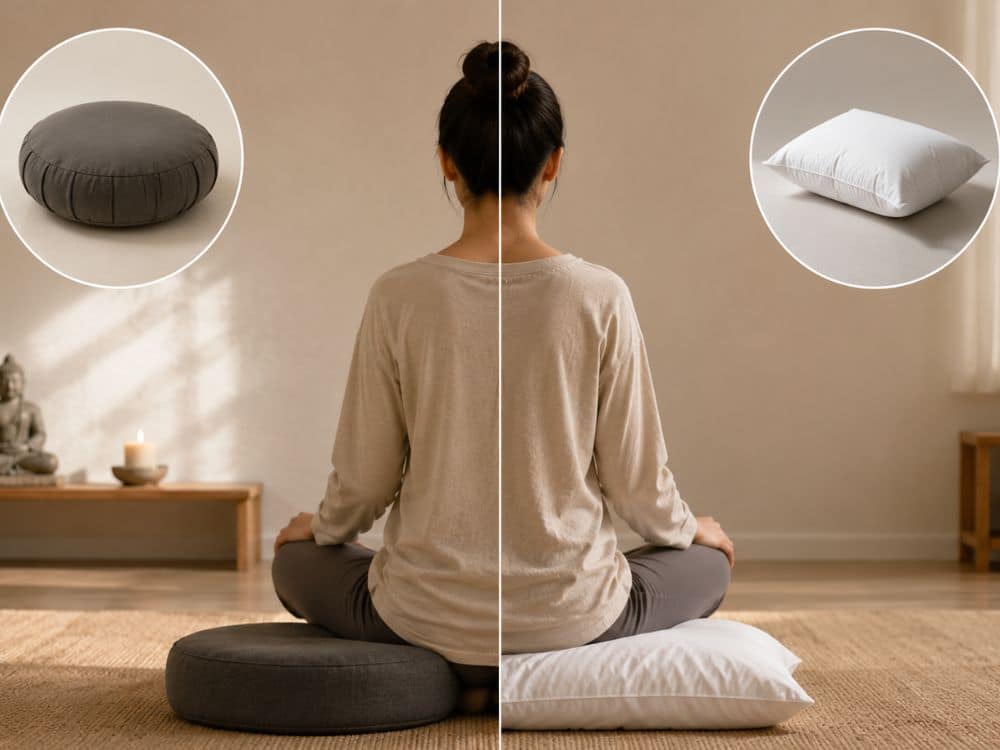
A regular pillow can help you test whether extra height makes sitting easier, but it is usually not stable enough for long Vipassana sitting.
The real decision is not “pillow or cushion?” It is whether your hips stay lifted, your knees and ankles have support, and your spine can stay upright without forcing the posture. Use this guide to understand what each support is meant to illustrate, then use the meditation cushion height guide if you need to fine-tune seat height.
- When a regular pillow is useful as a short test
- Why soft support often fails during longer sits
- When a zafu, zabuton, crescent cushion, bench, or chair makes more sense
- How to read product images as posture examples, not as pressure to buy gear
A pillow can teach you the problem, but it rarely solves long sitting
This is why searches like best meditation cushion for sitting comfort, best meditation cushion for bad knees, and meditation bench vs cushion should not all lead to the same answer. They point to different sitting problems.
The support names matter less than the job each one does
Regular pillow
A sleeping pillow used as a temporary sitting prop. It can show whether extra height helps, but it is usually too soft and changeable for long stillness.
Zafu
A meditation cushion used to lift the hips. If you are comparing zafu vs zabuton, the zafu is mainly the seat-height tool.
Zabuton
A larger mat placed under the body to cushion knees, ankles, and shins. It solves floor pressure, not seat height.
Crescent cushion
A curved cushion shape that can give the thighs more room and help some people with tight hips settle more naturally.
Meditation bench
A kneeling support that changes the leg position. It can be useful when cross-legged sitting repeatedly stresses the knees or lower back.
Chair
A chair is a practical support when floor sitting turns the session into pain management instead of meditation.
Use a regular pillow for a 10-minute test before buying anything
-
Sit on the pillow you already own
Do not judge it in the first 30 seconds. Sit for 10 minutes and notice whether the pillow keeps its height or slowly sinks under your hips.
-
Watch your pelvis and lower back
If your hips sink backward and your lower back rounds, the problem is likely unstable lift. That is when a firmer meditation cushion starts to make sense.
-
Notice whether the pillow tilts or slides
If one side compresses more than the other, your body may keep making tiny corrections. That is exactly what becomes tiring in long sitting.
-
Check knees, ankles, and shins separately
If the floor-contact points hurt, do not assume the seat is the only problem. You may need a mat, folded blanket, or zabuton-style support.
-
Track numbness early
Numbness can come from pressure, leg angle, or sitting longer than your body is ready for. For a deeper troubleshooting path, see how to sit longer in Vipassana without your legs going numb.
The point of this test is not to prove that a pillow is bad. It is to help you notice what changes over time: height, tilt, pressure, and stability. If you practice at home, a consistent quiet sitting corner for rest and reflection can make the test easier to repeat without turning it into a gear project.

Why a pillow can feel good at first and fail later
- The height changes as the fill compressesA pillow may lift your hips at the beginning, then flatten gradually as your weight settles into it.Look forA support that keeps the same usable height after several minutes.AvoidJudging comfort only by the first moment you sit down.
- The pelvis can roll backwardWhen the seat becomes too soft, the hips may sink and the lower back may round without you noticing right away.Look forA base that lets the spine feel upright without gripping the back muscles.AvoidStacking soft pillows that collapse into a sloped seat.
- Small shifts become annoying in stillnessDuring Vipassana, you are not constantly changing posture. A support that slides, tilts, or bunches up becomes more noticeable over time.Look forA seat that stays predictable while you remain still.AvoidA pillow setup that needs frequent fixing.
- Softness can hide the real problemA pillow can feel comfortable while still giving poor structure. Long sitting needs both comfort and repeatable support.Look forA setup that makes the posture easier to repeat tomorrow.AvoidChoosing the softest option just because it feels cozy.
The cushion is not better because it is fancier
A good sitting cushion is trying to hold a stable base under the hips, not imitate bed-pillow softness.
A firmer cushion can maintain hip lift after a soft pillow begins to flatten. What matters is whether the support keeps its shape as the sit continues, not whether it looks more specialized.
Softness can help for a few minutes, but long sitting often needs firmness that keeps the pelvis from slowly sinking.
Comfort during a long sit is about what remains supportive after the first few minutes, not just what feels pleasant at the start.
A cushion should make the posture more workable. It should not promise a pain-free body or turn practice into gear dependence.
The right support makes sitting clearer. It does not replace listening to the body.

Choose support by the problem, not by the product name
Choose the next support according to the first problem that appears. A collapsing seat points to firmer hip lift; sore knees or ankles point to floor padding; crowded thighs point to more room; persistent cross-legged strain may call for a bench or chair.
If your hips sink and your back rounds, the seat may need firmer lift.
If knees, ankles, or shins hurt, the floor-contact points may need cushioning. If you already own both pieces, a proper zafu and zabuton setup is the next test before comparing more cushions.
If your thighs cannot settle, shape and hip room may matter more than raw height.
If cross-legged sitting keeps causing sharp pain, a bench or chair may be the better support.
If the floor hurts, a taller cushion may miss the point
- Seat height and floor padding are separate jobsA cushion lifts the hips. A mat or zabuton cushions the knees, ankles, and shins where they meet the floor.Look forA setup that supports both the pelvis and the floor-contact points.AvoidBuying a taller cushion when your knees are the part that hurts.
- Bad knees need pressure relief, not just willpowerIf knee pain is the main issue, changing the support surface can matter more than forcing a traditional posture.Look forSoft but stable padding under the knees and ankles.AvoidLetting sharp joint pain become the center of the sit.
- A blanket can reveal whether a zabuton helpsBefore buying a set, fold a blanket under the knees or ankles. If the pressure changes immediately, floor support is probably part of the answer.Look forA simple test that separates floor pain from hip-height problems.AvoidChanging the cushion and floor support at the same time without learning which helped.

Read your body before choosing the next support
-
If your hips feel stuck, test more room
Some people with tight hips do not only need more height. They need a shape that gives the thighs more space to angle down naturally.
-
If you are short, avoid assuming taller is better
Searches like meditation equipment for short people often come from over-height setups. A cushion that is too tall can create its own strain.
-
If the knees pull upward, do not push them down
Floating knees may point to tight hips, not laziness. Change the support instead of forcing the legs into a picture-perfect pose.
-
If one shape bothers you, test another shape
Round, crescent, bench, blanket, and chair setups all change the body differently. If the problem is numb legs rather than cushion softness, compare sitting positions for long meditation before buying another support. Compare one variable at a time.
When a crescent cushion explains the problem better than another round pillow
- Shape changes thigh clearanceA crescent cushion can make it easier to see how the legs need room to settle around the seat.Look forA shape that supports the hips without crowding the thighs.AvoidChoosing a shape only because it looks more advanced.
- Adjustability matters for tight hipsPeople with tight hips often need small changes in height and angle, not one fixed answer.Look forSupport that can be tested gradually.AvoidJumping straight to the highest or firmest option.
- Check whether the shape gives your thighs enough roomA crescent cushion can provide more space around the thighs, allowing the legs to settle more naturally when a round pillow or cushion feels restrictive.Look forEnough space for your thighs to angle downward without being pressed inward by the cushion.AvoidChoosing a crescent shape only for its appearance when a round cushion already supports your hips comfortably.

A bench or chair can be the right answer when cross-legged sitting takes over the practice
The posture should support attention. If cross-legged sitting becomes sharp pain, a different support may be wiser.
This is where a meditation bench vs cushion comparison becomes useful: the bench changes the leg position instead of only changing seat height.
A bench is a practical tool for kneeling posture, especially when the knees, hips, or lower back dislike cross-legged sitting.
The useful question is whether the support helps you sit steadily, not whether it matches someone else’s idea of a correct-looking setup.
A chair can be the most skillful support when floor sitting creates avoidable pain or constant posture struggle.
If the body is shouting the whole time, the seat is no longer helping the practice.
Ordinary discomfort and injury-type pain are not the same thing. If knees are the limiting factor, use this guide to choosing a meditation cushion for knee pain before assuming another zafu will solve the issue.

A simple order for choosing support without overbuying
Start with the support you already have and change only one variable at a time. This makes it easier to identify whether the real problem is seat height, floor pressure, hip room, or the sitting position itself. Once your setup feels stable enough, simple daily rituals for a calmer life can help you return to practice more consistently without turning every sit into another equipment decision.
- Start with the regular pillow
Use it to discover whether extra height helps, then watch whether the support collapses or shifts.
- Move to a firmer cushion only if the seat is the problem
A zafu makes sense when the pillow test shows that unstable hip lift is holding you back.
- Add floor support if knees or ankles are the problem
Place a folded blanket or zabuton beneath the knees and ankles. If the pressure eases without changing seat height, the floor – not the cushion – is the main problem.
- Change shape if hips or body proportions are the problem
If a round cushion crowds the thighs or keeps the knees lifted, try a crescent shape that leaves more room around the hips and legs.
- Change posture if pain keeps dominating the sit
If cross-legged sitting continues to cause sharp or persistent strain, try a meditation bench or chair instead of forcing the same position.
Stop adjusting once the setup feels stable enough for you to sit without constantly correcting your posture. If a regular pillow shows that you need firmer, longer-lasting lift, compare the best meditation cushion for Vipassana by posture and pain point.
FAQ
Can I use a regular pillow as a meditation cushion?
Yes, but use it as a test rather than a long-term solution. A regular pillow can show whether extra height helps your posture, but it may compress, tilt, or slide during longer sitting. If that happens, a firmer meditation cushion is usually more stable.
What is the best meditation cushion for sitting comfort?
The best meditation cushion for sitting comfort is the one that solves the problem your test reveals. Some people need firmer hip lift, others need a zabuton for knee and ankle pressure, and others need a bench or chair. Softness alone is not the same as long-sit comfort.
Is zafu or zabuton more important for long sitting?
They solve different problems. A zafu lifts the hips, while a zabuton cushions knees, ankles, and shins. If your back rounds, start with seat height; if the floor hurts, look at floor support.
Is a meditation bench better than a cushion for bad knees?
A bench can be better if cross-legged sitting repeatedly creates knee stress. It changes the leg position instead of simply raising the hips. That makes the meditation bench vs cushion decision a posture question, not just a product question.
Why do my legs go numb during Vipassana sitting?
Numbness can come from pressure, leg angle, hip position, or sitting still longer than your body is ready for. A taller cushion helps some people, but floor padding or a different posture may help others. Start by changing one variable at a time.
Do short people need different meditation equipment?
Short people may need lower or more adjustable support, but it depends on hip mobility and knee position. A cushion that is too tall can create strain, while one that is too low can make the back round. Test height gradually before choosing a cushion shape.
Is a chair okay for Vipassana?
A chair can be appropriate when floor sitting creates sharp pain, unstable posture, or too much physical distraction. Sitting steadily in a chair is often better than spending the whole session fighting avoidable joint pain. If you attend a course, ask about available seating options.
The right support makes the sit clearer, not more complicated
- Use a regular pillow to test height, not to force long sitting.
- Choose a firm cushion when the pillow collapses or shifts.
- Add a zabuton or blanket when knees, ankles, or shins need floor support.
- Try a crescent cushion, bench, or chair when body fit matters more than tradition.
A regular pillow is not useless. It is useful because it shows you what changes when you add height. Once you know what fails – soft compression, floor pressure, tight hips, numb legs, or cross-legged strain – the next support becomes easier to choose. Use what you learned from the pillow test to choose the simplest support that solves the actual problem without adding equipment you do not need.