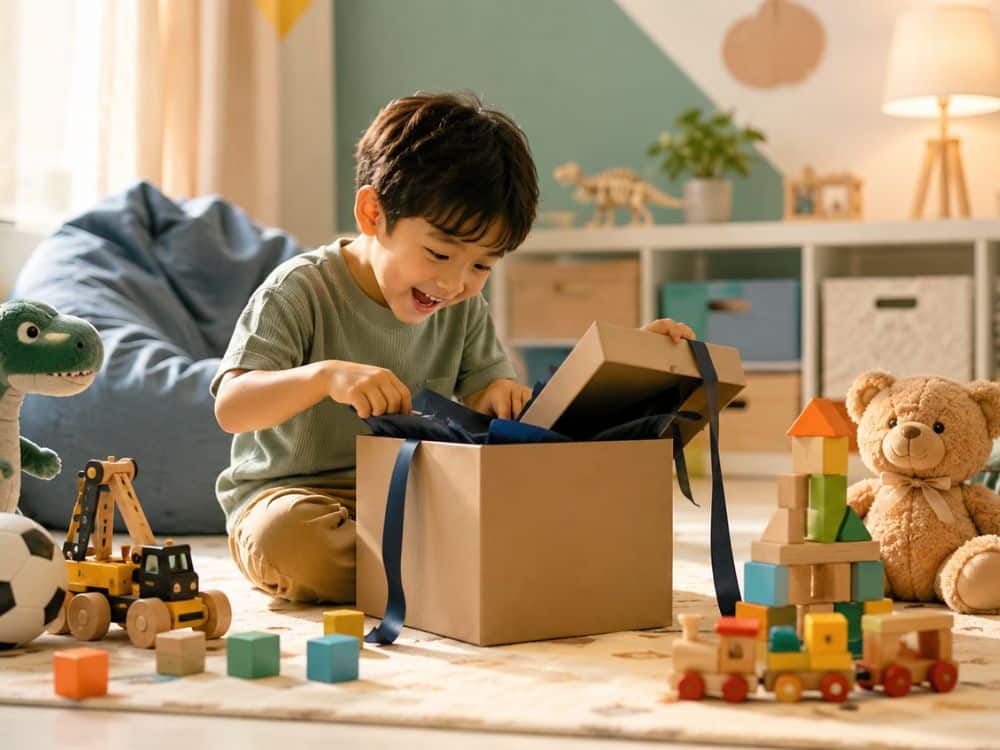
Children often reveal what holds their attention before they can explain it clearly. They build the same kind of structure again, turn blankets into rooms, cover pages with one favorite subject, or create a new route across the floor every afternoon.
A thoughtful gift does not need to decide what a child should become. It can simply notice the kind of play the child already returns to and provide a little more room for curiosity, movement, storytelling, or making. This guide belongs to the wider Gifting collection, where the recipient’s real habits matter more than the product category.
- Extends a kind of play the child repeats
- Allows meaningful choices during play
- Fits the home and adult workload
- Remains useful without forcing one result
The broader page on thoughtful gifts for children considers everyday comfort, creativity, shared time, and practical family life. This guide goes one step closer by watching what the child actually does when no one tells them how to play.
Watch What the Child Does Without Being Prompted
The clearest clues often appear during ordinary play, not while the child is looking through a catalog or reacting to a brightly packaged toy.
- Notice what they repeat
An activity the child begins independently and returns to across several days is a stronger signal than something used only after an adult suggests it.
- Watch ordinary objects
Boxes, blankets, cups, paper, cushions, sticks, and chairs may reveal an interest in building, arranging, pretending, moving, or making.
- See whether they follow or invent
Some children enjoy a clear sequence and visible finished result. Others resist instructions because deciding what happens is the part they value most.
- Notice the social pattern
The child may prefer solitary play, playing beside another child, leading a group, following an older sibling, or inviting an adult into only part of the activity.
- Separate the play from the character
A temporary interest in a movie or character does not always reveal whether the child enjoys puzzles, construction, storytelling, collecting, drawing, or role-play.
Observation does not require labeling the child. It only helps the gift meet the play that is already happening.
When They Keep Building and Rebuilding
A construction gift fits best when the child enjoys testing balance, shape, height, connection, and change—not only displaying a finished model.
Some children build toward a clear image. Others begin with one wall, add a bridge, remove a tower, and discover the idea while their hands are moving. For them, rebuilding is not failure or indecision. It is the activity itself.
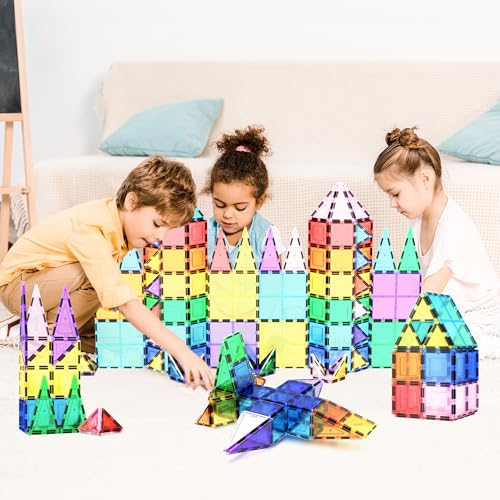
Magnetic tiles can illustrate this open construction pattern because the same pieces can become buildings, roads, animals, patterns, or unfamiliar shapes. The real fit still depends on the child’s age, the size of the pieces, the strength and condition of the magnets, and whether the household can keep damaged parts away from younger children.
Do not assume that a larger set automatically creates better play. A child may already have enough pieces to build freely and need only a stable surface or a simple way to preserve part of a structure overnight. Watch where the current limit actually appears before adding more.
When They Turn Materials Into Their Own Ideas
A Dedicated Surface Helps When Making Happens Often
A dedicated art table makes sense when creative materials already appear several times a week and the family has room for the furniture. The table should serve an existing pattern rather than announce that the child is now expected to produce artwork there.

Measure the room before buying. A table may be wide enough for paper but leave too little space to pull out both chairs, open the storage bins, or walk safely around it. Check the working height, chair size, paper-roll replacement, and whether paint or markers can be cleaned from the surface.
The table should not become a place where adults correct every drawing or preserve every sheet. Some work will be experimental, repetitive, unfinished, or immediately discarded. A useful creative space protects the child’s right to make without turning every result into a performance.
A Mobile Supply Station Fits Play That Moves
A rolling cart can keep paper, yarn, tape, pencils, and small tools together while allowing the work surface to remain flexible. The value is not the number of drawers. It is whether the child can see, reach, and return the materials with an amount of help that matches their age.
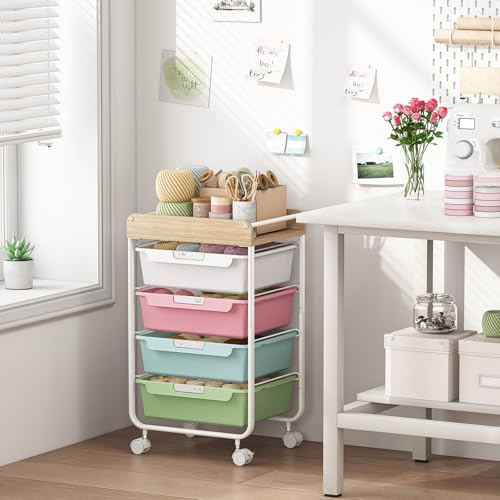
Check the wheel locks, drawer weight, sharp tools, and whether younger children can access materials that require supervision. A mobile cart should not become an unsorted container adults roll out only on special occasions. Its organization needs to be simple enough for the child to understand.
For an older child whose drawing, sewing, model-making, or craft practice has become consistent, the same care used to support an existing hobby becomes relevant: match the materials already used, avoid unnecessary duplication, and do not turn enjoyment into a larger assignment.
When Stories and Pretend Play Lead
Small Scenes Leave More of the Story to the Child
A small dollhouse living room can provide a setting without deciding the full story. A sofa, television, fireplace, or soft character may be rearranged, ignored, shared with other figures, or used in a story that has little to do with an actual living room.
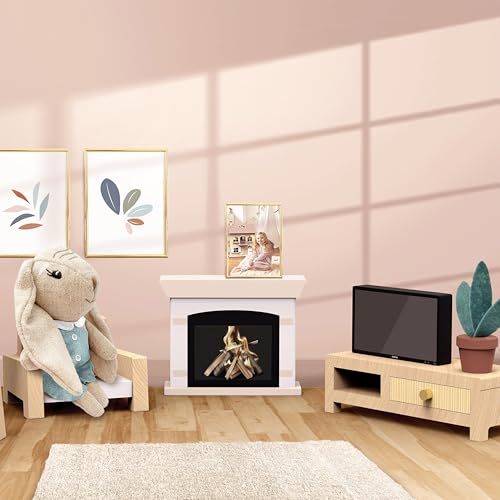
Small-world play suits children who enjoy arranging scenes, moving characters, repeating conversations, and controlling a story from outside it. Check scale before adding pieces to an existing collection. Furniture designed for one doll size may look attractive but be unusable with the figures the child already prefers.
Count the pieces and think about younger siblings, pets, vacuum cleaners, and the place where an unfinished scene can remain. The child may care deeply about returning to the exact arrangement later, even when the setup appears random to an adult.
Larger Role-Play Sets Need More Space and Adult Work
Some children want to place a figure on a tiny sofa. Others want to become the cook, customer, parent, shopkeeper, or host themselves. A larger play kitchen may fit that whole-body form of pretend play, but it also changes the room around it.

Measure the floor space, height, doors, and storage before choosing a large role-play set. Consider assembly, wall anchoring, batteries, sound controls, and the number of accessories that need to be managed. The family should not have to move the kitchen every evening simply to use the room normally.
The adult does not need to teach the child the correct way to cook, shop, or care for someone. A spoon can become a microphone, the oven can become a pet’s house, and the refrigerator can hold imaginary treasure. The gift works when the child owns the story.
When Their Body Is Part of the Play
- Real playing spaceCount the room needed for movement between pieces, not only the footprint of the equipment itself.Look forA clear path away from furniture, stairs, doors, and hard cornersAvoidFitting active play into a space where the child must constantly stop or twist
- Surface and gripA toy used on carpet, wood, tile, grass, or pavement may behave differently on each surface.Look forStable contact and a surface allowed by the manufacturerAvoidAssuming a non-slip label works equally well everywhere
- Supervision needsAge guidance does not replace an adult’s knowledge of the child, the room, and nearby hazards.Look forA setup adults can supervise realisticallyAvoidEquipment that requires constant help the household cannot provide
- Storage after movement endsStackable or compact pieces still need a reachable place that does not create another tripping hazard.Look forA reset the child can gradually help completeAvoidLeaving active-play equipment scattered through shared walkways
For some children, play begins when the whole body enters the problem. They invent routes, test whether they can cross without touching the floor, repeat one difficult step, or change the rules after each attempt.
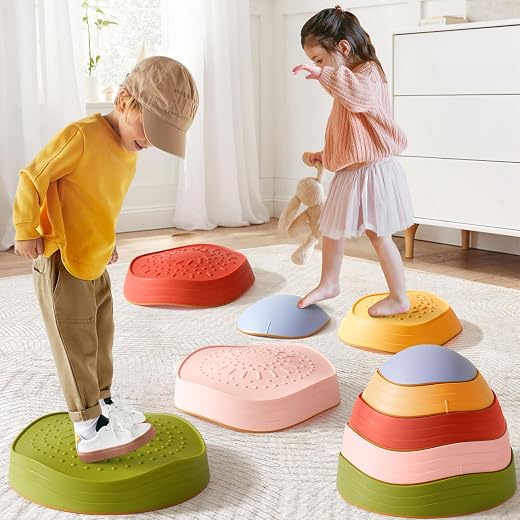
Stepping stones can illustrate this style of active play because children may arrange the route themselves and change the spacing as the game changes. The useful setup depends on a clear floor, suitable surface, adult supervision, and enough distance from cabinets, tables, stairs, and other hard edges.
Do not turn the activity into a test the child must complete correctly. One child may cross slowly, another may build a pretend island, and another may combine the pieces with stuffed animals or blocks. Movement remains play when the child has room to invent.
Count the Work Around the Play
-
Setup
Identify who opens packaging, assembles furniture, charges batteries, replaces paper, prepares materials, or clears the floor before play can begin.
-
Supervision
Decide whether the child can play independently, needs occasional help, or requires an adult nearby for the entire activity.
-
Noise and mess
Consider sound effects, falling pieces, paint, water, glue, clay, paper scraps, and whether the household has a realistic place to manage them.
-
Storage
Give every major group of pieces a place the child can see, reach, understand, and eventually help restore.
-
Pausing and resetting
Check whether an unfinished structure, picture, or story can remain intact without taking over a dining table, doorway, or shared room.
-
Ongoing supplies
Look for paper rolls, batteries, apps, subscriptions, refills, replacement parts, or accessories that create future cost and work.
The same question used for gifts that make everyday life easier belongs here: does the object remove friction, or quietly transfer more work to someone else?
Storage is part of the play cycle because a child can return only to what can be found again. Open bins and forward-facing books may help when the child currently forgets what is buried in deep boxes or needs an adult to retrieve everything.
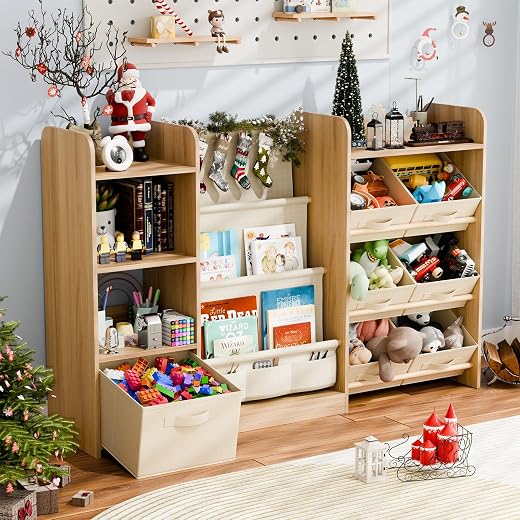
A large organizer is not automatically an organization solution. Measure the wall, baseboards, doors, and walking area. Check whether the upper shelves are reachable, whether the unit needs anchoring, and whether the removable bins become too heavy when filled.
Keep categories broad enough for the child to maintain: blocks, animals, vehicles, art materials, or dress-up items. A system that requires every tiny piece to return to a highly specific compartment may look orderly after an adult cleans it but fail during everyday family life.
Let Shared Play Stay Child-Led
Shared play helps when adults and siblings can join without taking over the rules, correcting every decision, or demanding that the child remain engaged.
The same principle behind time together without pressure applies here: participation should leave the child room to pause, change direction, or play alone.
Building, undoing, repeating, mixing materials, and leaving work unfinished may be the most meaningful parts of the play.
A finished result matters less when the child’s attention is focused on testing what can happen.
Learning can happen through movement, storytelling, repetition, imagination, negotiation, and experimentation without a product announcing a lesson.
A toy the child does not want to revisit gains little from being described as educational.
Adults can still make play richer by protecting time, finding a missing piece, listening to a story, or following a role the child assigns. The difference is that the adult supports the play rather than deciding what its result must be.
Shared gifts also need a plan for conflict. Siblings may want the same pieces, build at different speeds, or disagree about whether a structure can be changed. One larger set does not automatically create cooperation; sometimes separate materials and a shared space work better.
When a toy includes an app, account, camera, charging routine, or connected feature, apply the same checks used to choose technology they will actually use. The adult should understand privacy, permissions, ongoing cost, offline usefulness, and who will manage the setup after the excitement of opening has passed.
Run the Final Fit Check
- The child returns to this kind of playThere is repeated evidence in ordinary life, not only a recent request influenced by packaging, advertising, or another child.Look forSelf-initiated play across more than one dayAvoidBuilding the whole decision around one excited reaction
- The materials fit current abilitiesPieces, controls, tools, and instructions should allow participation without requiring adults to complete the meaningful parts.Look forEnough challenge to explore with a realistic entry pointAvoidA gift saved for some future version of the child
- The child can make real choicesThe activity should allow decisions about arrangement, story, color, route, pace, or outcome.Look forSeveral acceptable ways to engageAvoidA single correct result presented as open play
- The household can support itSpace, noise, mess, supervision, assembly, storage, and repeated cleanup belong to the gift decision.Look forWork that fits the adults’ actual time and homeAvoidExpecting family members to absorb hidden labor
- It does not duplicate an overflowing collectionMore pieces may help only when the child already uses the existing set and has room to combine and store the addition.Look forA clear gap or compatible extensionAvoidAdding volume because the category is familiar
- A smaller option would not work just as wellLarge furniture, extensive kits, and oversized sets need stronger evidence than a compact version or familiar household materials.Look forA real limit the larger gift solvesAvoidEquating physical size with thoughtfulness
The final decision does not require predicting how long the child will love the gift. Children change quickly, repeat unevenly, and often use objects in ways adults did not imagine. The better question is whether the gift meets the child where play is happening now without creating a larger burden around it.
Frequently Asked Questions
How can I tell what kind of play a child prefers?
Watch what the child begins without prompting, repeats across several days, and continues even when the materials are ordinary. Notice whether the activity centers on building, making, storytelling, movement, collecting, arranging, rules, or social interaction.
Should I choose a gift based on age or interests?
Use age guidance for safety and realistic difficulty, then use observed interests to understand the type of play. Age alone cannot show whether a child prefers open construction, guided projects, pretend stories, or active movement.
Are open-ended toys better than activity kits?
Neither is universally better. Open-ended materials suit children who enjoy inventing the process, while a contained kit may suit a child who prefers clear steps and a visible result. The child’s way of engaging matters more than the category label.
What if the child loses interest quickly?
Choose a smaller version, borrow a similar item first, or select materials that can support several forms of play. A short period of meaningful engagement is not necessarily failure, but a large permanent object needs stronger evidence.
How do I avoid buying duplicate toys?
Ask a parent or caregiver, look at the existing collection, and check brands, sizes, characters, and compatible systems. Similar-looking sets may not connect safely or function together.
Should siblings receive gifts they can share?
A shared gift can work when the children have compatible ways of playing and enough materials, space, and adult support. Separate gifts may be kinder when age, attention, ownership, or play styles differ significantly.
Are educational toys always a better choice?
No. A toy becomes useful through the child’s engagement, not through the word educational on the package. Ordinary building, pretending, drawing, sorting, and movement can involve sustained attention, experimentation, language, and problem-solving.
Give Them More Room to Play Their Way
- Watch what the child begins independently
- Match the gift to the form of play
- Count space, storage, and adult work
- Leave the child in charge of the result
A thoughtful gift does not need to direct a child toward the person adults hope they will become. It can notice the child who builds and rebuilds, covers paper with private ideas, gives tiny furniture a whole history, turns the floor into a new landscape, or returns to the same story in a different form. The best fit gives that play a little more room while allowing the child to keep deciding what happens next.