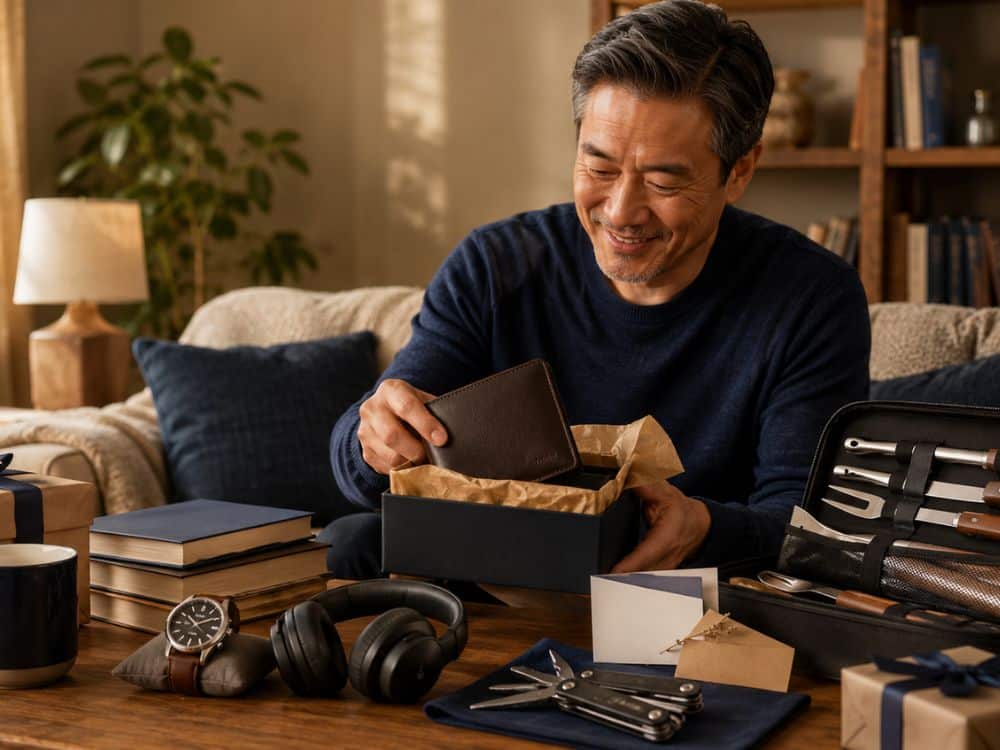
Thoughtful gifts for Dad become easier to choose when you stop searching for an impressive object and start noticing the life he already lives.
Dad may still make the process difficult. He may say he needs nothing, buy necessary things for himself, or answer every question with “Don’t spend your money.” That does not mean he is impossible to shop for. It usually means a generic list will tell you less than one quiet week of paying attention.
The goal is not to discover a product no father has ever seen. It is to choose something that feels as though it belongs in his home, his hands, or his week. A modest gift that fits can feel far more thoughtful than an expensive surprise that leaves him wondering where to put it.

Start with the life he already has
The safest clues live in ordinary routines: morning coffee, weekend repairs, evening reading, gardening, cooking, driving, or calling family.
A thoughtful gift often removes one small annoyance instead of creating a dramatic new experience.
Dad may value simplicity, privacy, familiar controls, or clear surfaces more than extra features and elaborate presentation.
Some moments call for an object. Others are better answered with a meal, a visit, setup help, or one task quietly handled.
Begin with observation rather than interrogation. Asking “What do you want?” often produces the answer you already know: nothing. Look instead at what Dad repeatedly does, carries, repairs, postpones, or enjoys when no one is arranging the moment for him. Frequency matters more than novelty because a familiar moment made easier, warmer, or less cluttered has a natural place in his week.
Do not confuse an interest with an identity assigned to him. Owning a grill does not make grilling his passion, and watching one bird documentary does not automatically require a smart feeder. Condition and relationship matter too: a worn wallet may invite replacement, while a sentimental keepsake or recovery tool may feel caring from one person and intrusive from another. Thoughtfulness includes noticing the clue and knowing how close to stand.
Match the gift to his daily rhythm
When he values usefulness over surprise
- Give it an obvious purpose
Dad should be able to understand where the gift goes and what it improves without a ceremonial explanation.
Look forOne familiar task or recurring annoyanceAvoidAn object that exists mainly to look impressive - Check real frequency
A workbench organizer, grilling tool, or charging station fits only when the related routine already happens regularly.
Look forWeekly use or an established setupAvoidA hobby suggested by Father’s Day advertising - Find its natural home
Storage belongs in the decision before the gift enters the house.
Look forA place where it replaces, organizes, or improves somethingAvoidLeaving Dad to store the evidence of your thoughtfulness - Count the work it creates
Setup, cleaning, charging, maintenance, and learning can turn a useful-looking gift into another project.
Look forA benefit that clearly outweighs the effortAvoidConvenience for the giver and homework for Dad
The strongest practical choices solve a familiar annoyance. Function gives the object a place in Dad’s life; remembering the keys he searches for or the old tool he keeps repairing gives it meaning.

When long days have started to show
- Everyday comfort
Notice what happens when Dad comes home: he may take off his shoes immediately, settle into the same chair, rub his shoulders, reheat his coffee, or stay quiet until the day loosens its grip. These small routines can show where gentleness might fit. Comfort gifts should reduce effort and support the way he already rests – not require an account, a training plan, complicated maintenance, or a promise to become a new person by Monday. Soft slippers by the door, a warm drink that stays warm, better support in a familiar chair, or something enjoyable for an unhurried evening can make an ordinary day gentler. These evening comfort ideas work because they meet him where he already rests.
- Recovery-focused support
When sore muscles, restless sleep, or long hours on his feet keep repeating, carefully chosen self-care gifts for dads may offer more relevant support than another general-purpose gift.
- Medical care
Persistent or worsening pain, sleep problems, or circulation concerns need qualified advice. Do not present a pillow, blanket, massage device, or pair of slippers as treatment. A consumer product may support comfort, but it cannot diagnose or treat the underlying problem. Sometimes care means encouraging Dad to seek professional advice.

When he enjoys things quietly
- Do not measure the gift by his reaction A nod and a quiet thank-you may be genuine appreciation, not proof that the gift failed.
- Leave room for private enjoyment Books, familiar music, coffee on the porch, birdwatching, or a simple game can feel personal without creating a performance.
- Follow his natural energy One companion, a familiar hobby, or an afternoon at home may suit him better than a crowded event or ambitious experience.
Choosing something personal but low-pressure lets Dad enjoy being understood without being watched for the correct response.

Shared activities work especially well when attention rests on the activity rather than the emotion surrounding the gift. Two people can play, walk, cook, watch a match, or finish a small project without explaining what the time together means. The meaning is allowed to arrive on its own.
When family connection matters most
Family gifts can become sentimental quickly, but sentiment works best when it remains connected to living relationships. A framed photograph is lovely; a steady stream of ordinary family moments can make the home feel less distant. A memory book can preserve stories; sitting with Dad while he tells them gives those pages a voice.
Technology can help, but only when the family accepts responsibility for its share of the work. A digital frame needs setup, internet access, and people willing to keep adding photographs. A video-calling device needs contacts and controls Dad can understand. Giving the device and disappearing behind the instruction manual is not connection.
A photo display becomes meaningful when the family continues adding ordinary moments instead of filling it once and forgetting it. For relatives who live far apart, sharing new photos can keep family life present without asking Dad to manage albums or print pictures.

Consider Dad’s comfort with screens, apps, passwords, and notifications. “Easy setup” may still mean account creation and Wi-Fi troubleshooting. The more technology the gift contains, the more valuable it becomes to connect everything yourself and leave one clear instruction card.
Connection does not have to be digital. A recurring breakfast, a monthly game, a shared garden task, or a standing Sunday call may serve the same need. Research published in the Journal of Consumer Research found that experiential gifts can strengthen relationships more than material gifts because of the emotion created while the experience is lived. The useful lesson is not that experiences always win, but that the best gift may continue after the package is opened.
Let his season of life shape the gift
A new rhythm after retirement
- Leave room for an unsettled rhythm Some dads enter retirement with plans; others need time to discover what an ordinary Tuesday feels like without work shaping the day.
- Support an interest that already exists Tools for a familiar hobby, comfort for slower mornings, travel help, or family time can invite rather than assign.
- Respect the identity change Work may have supplied structure, expertise, purpose, and daily contact. The transition deserves more attention than a novelty retirement message.
The most useful retirement gifts support the life Dad already wants to explore instead of handing him homework with a bow attached.

Gardening illustrates the difference. A few sturdy hand tools make sense when Dad already tends plants, talks about starting herbs, or keeps wandering toward the garden center. The same tools are less thoughtful when he dislikes dirt, has limited mobility, or lives somewhere without usable outdoor space. The product does not create the fit; his life does.
Support during grief should begin with presence
When Dad or another paternal figure has lost a spouse, gift language can become painfully inadequate. A cheerful object may feel disconnected from what has happened. A highly sentimental memorial may arrive before he is ready. Even a well-meant question – “What do you need?” – can place another decision on someone already carrying too many.
-
Remove one specific burden
Bring dinner on a named evening, take out the bins, replace a hallway bulb, or handle one household task without making him coordinate the help.
-
Offer company without demanding disclosure
Sit for coffee, drive him to an appointment, or share a quiet meal without requiring a conversation about grief.
-
Let memory gifts follow his pace
Photographs, keepsake boxes, scanned letters, and family stories can be meaningful, but they should not make grief public or performative.
-
Return after the obvious dates
Set reminders for the weeks and months after the funeral, as well as holidays and anniversaries, when support often becomes thin.
After a loss, steady practical care usually matters more than another object, especially when it continues after the first wave of attention has passed.

The casserole dish is not the story. The story is that someone cooked, arrived, and removed one decision from the evening. Grocery baskets, warm bedding, home-safety items, or useful tools matter because of the care surrounding them; no product can repair the loss.
Ordinary days can carry the most meaning
- Let the message be “I noticed” Replace the cracked mug, bring the snack he keeps in the cupboard, print one unseen photograph, or help with a postponed task.
- Distribute care across time A book this month, breakfast next month, photo help later, and regular calls in between can mean more than one perfect object.
- Do not underestimate familiar replacements The same coffee, socks, notebook, garden gloves, or pantry treat can be thoughtful when it reflects a preference you remembered.
An ordinary-day gift can remain small because it does not need to compete with a holiday. Its strength comes from specificity, not presentation.
Choose the occasion without letting it choose the gift
Father’s Day, birthdays, retirement parties, Christmas, and family milestones create a reason to give, but they do not tell you what Dad should receive. A Father’s Day guide can narrow the timing and presentation choices; Dad’s real routines must still determine the direction.
A fixed date may make personalization, complicated shipping, or an experience with many arrangements less practical.
A birthday may carry personal history, retirement may acknowledge an identity change, and a simple thank-you may call for restraint.
Set an amount that suits your circumstances and relationship. Cost expands the options, but it cannot manufacture fit.
A handwritten note, shared time, or setup help can make a modest gift more useful and personal without raising its price.
The occasion belongs around the decision, not at its center. Care has more than one currency.
Run a no-buy check before you decide
- Does it fit something he already does?
A recurring habit, real interest, or familiar responsibility gives the gift a natural place in his life.
Look forWeekly use, an existing setup, or a need Dad has mentionedAvoidA fantasy version of how he should spend his time - Will it remove effort or add effort?
Setup, charging, cleaning, subscriptions, storage, maintenance, and learning all belong in the decision.
Look forA clear benefit that outweighs the work requiredAvoidA gift that becomes another unfinished task - Is the choice for him or for you?
Style, technology, hobbies, sentiment, and comfort are personal. Your favorite version may not be his.
Look forHis colors, habits, controls, pace, and tolerance for clutterAvoidBuying the product you would want in his position - Would a gesture serve the need better?
Connection, grief, fatigue, and major transitions are not always best answered with another possession.
Look forTime together, a meal, setup help, a repeated check-in, or one task handledAvoidUsing a purchase to avoid showing up - Will the gift still make sense afterward?
Picture the ordinary week after the celebration, when the wrapping is gone and the object needs a role.
Look forRepeat use, a storage place, or a continuing shared activityAvoidOne-day excitement followed by permanent clutter
Where is Dad using it? What is he doing? Who sets it up? Where does it live, and what happens when it needs cleaning, charging, refilling, or storing? When the ordinary scene remains clear, the choice is usually grounded. When the scene disappears and only the product remains, pause.
This check does not remove joy from giving; it protects the reason you wanted to give. Asking directly is allowed too. Dad may appreciate two sensible choices for clothing, comfort products, technology, tools, or anything expensive. A requested gift can still be thoughtful because you listened, remembered, and followed through.
Questions people ask when Dad gives no clues
What is a thoughtful gift for a dad who says he wants nothing?
Start with something that does not ask him to become a different person. Replace a worn everyday item, support a routine he already enjoys, bring a favorite meal, handle one lingering task, or plan quiet time together. His refusal may also be sincere, so respect it; a note, call, or shared breakfast can express care without adding another possession.
How do you choose a gift for a dad who has everything?
Stop trying to find an object he has never encountered. Look for a better version of something he uses, help maintaining or organizing what he owns, consumables tied to a real preference, an experience that suits his energy, or a family connection that continues over time. “Has everything” often means the useful categories are already visible.
Is a practical gift too impersonal?
Not when the reason is specific. A practical gift becomes personal when it reflects something you noticed: the keys he misplaces, the coffee that goes cold, the garden tools he keeps repairing, or the chair where he reads every evening. Function gives the gift a place; your attention gives it meaning.
What can you give Dad that is not another object?
Offer a meal, a planned outing, a recurring phone call, help with technology, a day completing a home task, tickets to something he already enjoys, or time preserving family photos and stories. Keep the plan realistic and handle the details so the experience does not become work for him.
Should you ask Dad what he wants?
Yes, especially when size, comfort, personal taste, technology, cost, or storage matters. Ask about a category, offer two choices, or listen for what needs replacing. A requested gift is not less thoughtful. It can show that you valued Dad’s preferences more than your ability to surprise him.
How much should you spend on a gift for Dad?
Choose an amount that fits your finances, relationship, and the occasion. Price does not determine thoughtfulness, and overspending can make the gift uncomfortable to receive. A modest, well-matched gift with a personal note or useful help can carry more meaning than an expensive object chosen without context.
The best gift should feel like it belongs in his life
- Observe what Dad already repeats, uses, enjoys, and quietly tolerates.
- Choose one direction that fits his daily rhythm or current season of life.
- Count setup, storage, maintenance, and emotional pressure as part of the gift.
- Let products support care without turning every need into a purchase.
- Remember that time, practical help, and steady connection are gifts too.
Look at the life he already has. Choose something that can enter that life without demanding a new personality, a complicated routine, or a performance of gratitude. The right gift may be useful, comforting, quiet, shared, or very small. It may even be dinner at the door and the promise to return next week.
When the choice feels natural in an ordinary part of Dad’s day, you are probably close.