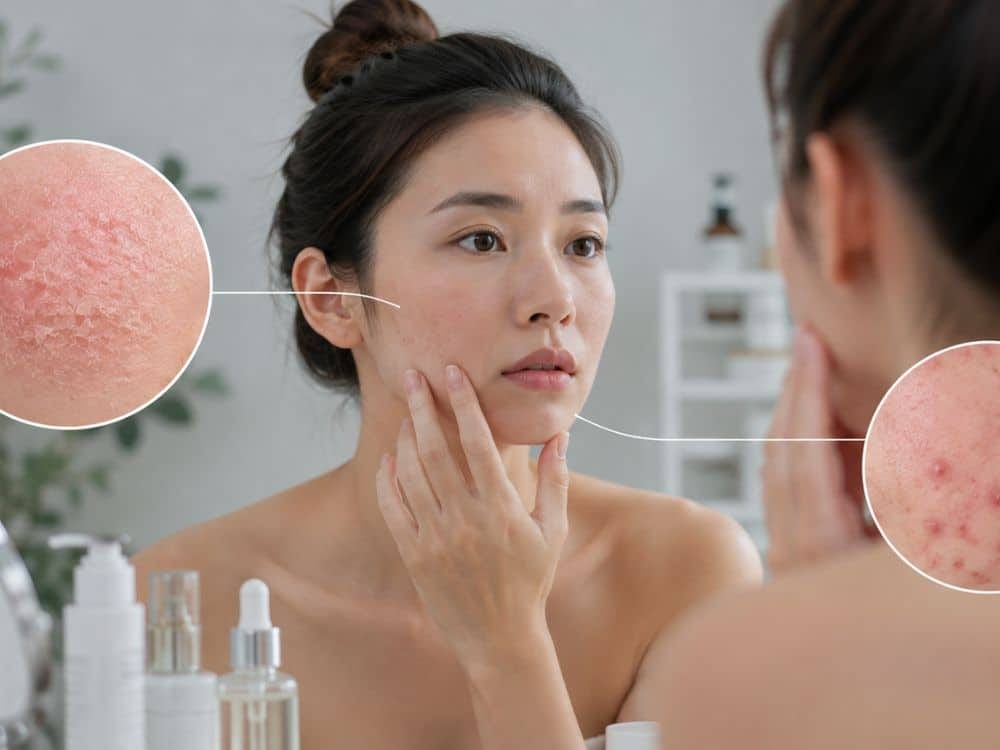
A new cluster of bumps can make the bathroom shelf feel like a lineup of suspects. The question behind damaged skin barrier vs breakout is not simply what the skin looks like, but what changed, how the skin feels, and whether the pattern resembles your usual breakouts.
A breakout after new skincare product use can reflect several different situations: a familiar acne pattern, irritation, a disrupted barrier, or a temporary change associated with certain turnover-accelerating ingredients. Those possibilities can also overlap. The aim here is not to diagnose your skin from a mirror; it is to gather enough useful evidence before you replace several products at once. Simplifying your skincare routine makes that evidence easier to see because fewer simultaneous changes compete for attention.
What to notice before changing anything
These observations are clues, not a home diagnosis. Skin can show acne and barrier disruption at the same time, so the most useful first step is an accurate description rather than a confident label.
Damaged skin barrier vs breakout
Compare the evidence, not just the bumps
- How the skin feelsBarrier irritation often announces itself through sensation. Products that were previously comfortable may suddenly sting, and the face may feel tight after cleansing or tender when touched.Look forStinging, burning, itching, tightness, or tendernessAvoidTreating discomfort as proof that a product is working
- How widely the change appearsA breakout commonly forms as distinct lesions, while irritation may affect the surface around them as well. Notice whether redness, roughness, or discomfort extends beyond each bump.Look forLocalized lesions versus diffuse surface discomfortAvoidJudging the whole pattern from the largest spot
- Whether the pattern is familiarCompare the new change with your own history. Similar lesions in familiar areas carry different meaning from tiny bumps, rash-like texture, or redness in places that rarely break out.Look forUsual zones, usual lesion type, and usual sequenceAvoidAssuming every new bump has the same cause
- What accompanied the bumpsDryness, flaking, rough patches, and stinging with ordinary products are among the commonly described signs of a damaged skin barrier. Acne can still be present beside those signs.Look forA cluster of surface changes rather than one isolated symptomAvoidForcing the situation into an either-or answer
Do not mistake discomfort for progress

Where purging fits – and where it does not
- A familiar breakout
A pattern resembling your usual acne in lesion type, location, and progression. Blackheads, whiteheads, or inflamed pimples may be present without widespread stinging or flaking. Familiarity adds context, but it does not identify the cause with certainty.
- Barrier irritation
A change in how the skin surface looks and feels, often involving tightness, dryness, roughness, redness, tenderness, or stinging when ordinary products are applied. The recognized signs of barrier damage include dry or flaky skin, irritation, itchiness, rough patches, sensitivity, and stinging. This category can coexist with acne rather than replacing it.
- Skin purging
A commonly used label for a temporary increase in blemishes after starting an ingredient that accelerates skin-cell turnover, such as a retinoid or exfoliating acid. The explanation becomes less convincing when the product does not affect turnover, the reaction appears in unfamiliar areas, or burning and rash-like redness dominate. That distinction is the practical center of skin purging vs irritation.
- Product-related breakout
New clogged pores or inflammatory lesions that follow a formula, application pattern, or routine change. Texture, occlusiveness, frequency, removal, and the combination of several products may all matter. Repeated irritation can sit behind the feeling that products seem to stop working. A reaction does not automatically mean the product is universally bad; it may simply be a poor match for this skin or this routine. Photographs cannot reliably distinguish every acneiform rash, allergy, infection, or dermatitis, so a persistent, painful, or worsening pattern belongs with a qualified clinician.

Trace the reaction before changing products
- Mark the last stable routine
Write down the cleanser, moisturizer, sunscreen, treatments, and makeup used while the skin still felt normal. This creates a baseline instead of comparing today with a vague memory of ‘better skin.’
- Add every recent change
Include new products, restarted products, stronger concentrations, extra applications, exfoliating tools, masks, professional treatments, travel, and unusually dry or humid weather. A familiar bottle used twice as often still counts as a change.
- Record the first symptom, not only the first bump
Note whether tightness, warmth, itching, stinging, roughness, or redness came before the visible breakout. The order may reveal that irritation began before clogged or inflamed lesions became obvious.
- Map location and progression
Record where the reaction started, where it spread, and whether each area matches a usual breakout zone. A few photographs taken in similar lighting can document change without turning the mirror into a twenty-four-hour surveillance department.
- Review prescribed products separately
Do not independently stop, restart, or change the frequency of a prescribed acne medication. Contact the prescriber when irritation develops; adjustments to prescribed treatment should be made with professional input.
- Choose the smallest useful change
A recent non-prescription cosmetic that coincides with stinging, itching, or spreading redness is one clear variable to question. Keep the last comfortable routine visible and avoid replacing several products on the same day, because the response becomes harder to interpret.
The purpose is not to create perfect laboratory conditions in a bathroom. It is to stop changing products too quickly and preserve enough consistency to understand what the skin is responding to. Dermatologists’ acne-care advice also cautions that trying new treatments too often can irritate skin and contribute to breakouts.
Know when observation is no longer enough
Can a damaged skin barrier cause breakouts?
Barrier disruption and breakouts can occur together, and irritation may complicate acne care. That does not allow a single bump pattern to prove which process came first. The useful response is to document both the lesions and the surrounding sensations.
How can I tell whether a new product is purging or irritating my skin?
Start with the ingredient’s expected action, the timing, the location, and the way the skin feels. A turnover-accelerating active makes purging more plausible; burning, itching, swelling, diffuse redness, or a reaction in unfamiliar areas makes irritation more concerning. Uncertainty that persists deserves professional assessment rather than an extended product experiment.
Should I keep using a product to see whether the reaction passes?
Persistent burning, stinging, itching, tenderness, or worsening redness should not be treated as a routine endurance test. A prescribed medication needs a conversation with the prescriber before changes are made. A clinician can also assess reactions that continue after the suspected cosmetic is no longer used.
When does a skin reaction need prompt medical attention?
Seek prompt care for a painful rash, rapid spread, blisters, open sores, fever, involvement of the eyes, lips, mouth, or genital skin, or signs of infection such as pus, warmth, swelling, or crusting. The American Academy of Dermatology’s rash warning signs include these patterns. Trouble breathing or swelling of the lips, tongue, throat, or face requires emergency care.
What should I record before a dermatology appointment?
Bring the product names or ingredient lists, start dates, application frequency, symptom timeline, affected areas, and photographs taken under similar lighting. Include prescription and over-the-counter products. This record gives the clinician a clearer sequence than a bag of bottles accompanied by the understandable sentence, ‘Something in here betrayed me.’
Change less until the pattern is clearer
The most useful answer to damaged skin barrier vs breakout rarely comes from inspecting one blemish more intensely. Notice the timing, sensations, distribution, texture, and product changes as one connected pattern. Keep the last comfortable routine visible, question one variable at a time, and bring persistent, painful, spreading, or uncertain reactions to a qualified clinician. Your skin does not owe you a neat label overnight; it does deserve decisions based on more than panic in front of the mirror.