
I have had evenings when one perfectly ordinary question felt like one question too many. Work was finally over, but the dishes were waiting, laundry was sitting there with its usual excellent timing, and dinner had apparently decided not to cook itself.
Then someone I loved asked me something simple, and I answered with far more irritation than the question deserved. My family had not created the deadlines or difficult conversations. They were simply standing closest when I carried the workday home.
A 10-minute transition ritual between work and home gives that handoff a little room: leave a clear stopping point for work, take a brief pause without adding more demands, then return to the people and tasks waiting at home. It will not make every difficult day disappear. It may help you notice the mood you are bringing through the door before somebody else receives it.
-
Minutes 1–2: Leave work a stopping point
Capture the unfinished task and its next step, close what you can close, and put work materials aside.
-
Minutes 3–7: Take one undemanding pause
Change clothes, sit with a drink, move gently, or take a short walk. Choose one; do not fit every relaxation idea into five minutes.
-
Minutes 8–10: Return without rushing
Notice your mood, tell the people at home what you need, and choose the first ordinary thing to do next.
The timings are a practical example, not a tested treatment or a deadline for feeling calm. A shorter version counts.
My ten-minute transition from work to home
The pause begins when work actually ends: at the desk, when the work bag goes down, or after the last handover of a shift.
It does not have to happen at 5:00 PM, and it does not require buying anything. The useful order is to give work a stopping place before asking yourself to settle into home life.
Minutes 1 – 2: Give unfinished work somewhere to wait
A closed laptop does not settle an unfinished task. Before leaving, write the item that is most likely to keep returning to your mind, then give it a concrete next step. “Finish the report” is vague; “At nine tomorrow, open the draft and check the missing figures” tells you where to resume.
Use the work system where that information belongs. A notebook is fine for an ordinary reminder, but confidential details should stay in the approved workplace system.
The purpose is not to plan the whole week or start completing the task. It is to stop asking your memory to keep watch over it all evening.
There is some evidence behind this step. In research on psychological detachment, making specific plans for incomplete work goals improved detachment among employees who tended to find it difficult.
That supports trying a brief next-step note; it does not establish that this whole ten-minute ritual works for everyone.
Then end the practical part. Save your work, complete any necessary handover, and close the programs you no longer need. Silence nonessential work alerts if your role allows it.
If you already wrote a useful stopping note before the commute, you do not need to reopen the laptop at home to do it again.
Minutes 3 – 7: Choose one pause you do not resent
Some days I notice the workday most clearly when I finally stop moving. My jaw is tight. My shoulders have spent the afternoon trying to become earrings. On those evenings, sitting down or moving gently can make more sense than giving myself another ambitious activity.
Take off work shoes or change out of uncomfortable clothes if that helps. Then choose one thing for the remaining minutes: sit quietly, make a familiar drink, walk a little, or stretch gently within a comfortable range.
You do not have to do all four. If the kettle is slow, the five minutes need not include finishing the tea.
A compact massage tool can be an optional part of that pause if you already enjoy using one. It is not the thing that makes the transition work, and it should not be presented as a way to force the body into relaxation.
Follow its instructions and stop if it feels uncomfortable. Simply resting your arms and letting your shoulders drop requires less setup.

For me, the drink is often useful because it gives my hands somewhere other than the phone to go. I know how this usually begins: I am only checking something while the kettle boils.
Then there is a message, a headline, a video, and suddenly I know several strangers’ opinions about a problem I did not have five minutes ago.
Tea, plain warm water, or another familiar drink can all fit. The point is to stop adding input for a few minutes. Put the phone aside before preparing the drink, then sit somewhere you do not also use to answer work messages.

If deciding what to do becomes a daily negotiation, the separate article on choosing one after-work ritual is the better place to explore your options. Here, the activity is just one part of a handoff. Keep the one that fits you and leave the rest.
Minutes 8 – 10: Step back into home life deliberately
These last minutes are not a test of whether you feel perfectly peaceful. Notice what is still there: irritation, hunger, tired feet, or the urge to answer every question quickly so people will stop asking. That information is more useful than deciding you should already be calm.
I like remaining seated a moment longer. By now I can see the washing, hear a cupboard opening, and remember dinner. My instinct is to get up and start serving the evening immediately. Staying put briefly interrupts that rush.
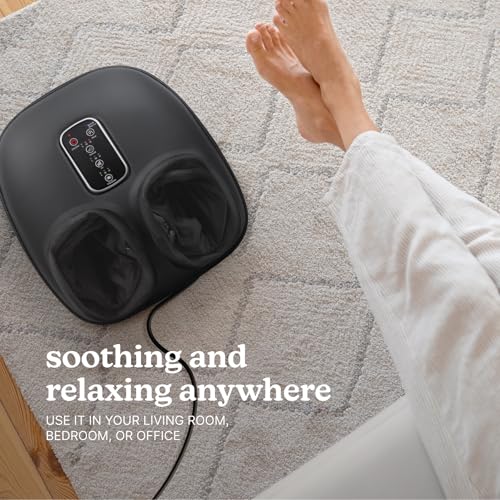
If you already use a foot massager and find it comfortable, it can accompany the seated pause. It is optional. Feet resting on the floor or a cushion may be enough, particularly when getting out a machine would take longer than the time you have.
Then choose the first thing you are returning to, rather than mentally taking on the whole house. Greet your family. Get some food if you are hungry. Ask what needs attention first. A simple sentence can help: “I’m glad to be home. It was a difficult day, so I may need a little time to settle.”
The ritual ends with rejoining the evening. It should not become a reason everyone else has to manage your mood indefinitely.
The pause is not another household job
The sink was right there. I could see the laundry. Dinner had still not cooked itself, which I considered rather inconsiderate. Letting those things remain unfinished for a few minutes felt harder than making the tea.
But the dishes looked much the same when the pause was over. What sometimes changed was the person standing in front of them. I had not become endlessly patient; I had a little distance from the last email or difficult conversation before beginning another set of demands.
That does not mean essential care should wait. A child needing help, an unsafe situation, or something genuinely time-sensitive takes priority. The useful distinction is between what needs you now and what merely becomes visible as soon as you come home.
If another adult is also coming home tired, agree on how both of you get a breather. Taking ten minutes for yourself while silently assigning every immediate responsibility to them solves only half the handoff.
On evenings when the whole day has already run late, I would not squeeze this exact sequence into an impossible schedule. A simple evening reset belongs to that later, lower-energy moment. This ritual belongs near the end of work, before the rest of the evening gathers speed.
When there is no commute – or no way to switch off completely
The same handoff looks different at a kitchen table, after a commute, or during an on-call evening. Keep the purpose, but change the logistics. A rule that only works for someone with a private office and an empty house is not much use in an ordinary home.
Working from home: leave tomorrow’s starting point, close the laptop, and clear enough space for the table to have its next use. Put work papers in one container or cover the equipment if it cannot be moved.
Stand up and change location for the pause, even if that means another chair rather than another room.
Commuting: write the stopping note before leaving work when possible. Part of the journey can be your transition, especially if you walk or use public transport.
If you drive, keep your attention on driving; any note-taking, phone changes, or eyes-closed exercise waits until you are safely parked. You do not owe yourself another ten minutes simply because some of the pause happened on the way.
On call or responsible for urgent contact: keep the agreed urgent channel available and silence what is not required. Decide in advance what counts as urgent and who should contact you.
The boundary may be “reachable for emergencies” rather than “completely unavailable.” If you are called back to work, make a fresh stopping point afterward instead of calling the evening a failure.
Shift work follows the same principle. “After work” may be early morning. Choose the version that fits what comes next, including sleep, rather than borrowing somebody else’s evening timetable.
When my family needs me before the pause is over
Real homes are not wellness retreats. People knock on doors. A child needs something, dinner needs coordinating, or somebody wants to tell you about their own difficult day. The pause needs to survive that without turning the people at home into interruptions.
Explain it at a neutral moment, before anyone is already upset: “When I get home, I’d like a few minutes to change and settle. After that, let’s sort out dinner together.” A clear return matters.
It is easier to respect a small pause when it does not sound like disappearing for an unspecified length of time.
If you are the only adult available, the pause may have to happen around care rather than behind a closed door. You might put work away, change clothes, and sit nearby while remaining attentive. The short version is not a lesser moral achievement; it is the version your situation permits.
- Leave one next step Give the unfinished work a place to resume, even if the note takes only a few seconds.
- Change one cue Put down the work bag, remove your work shoes, or close and move the laptop.
- Make your return clear Say what you need and what you will do next. Attend to immediate care without treating the interrupted pause as failure.
I do not want a ritual that makes everyone tiptoe around me. Three minutes with a warm mug can still create a pause. So can changing clothes and taking a quiet moment before answering the next question.
When the workday keeps replaying
A work thought returning does not mean you performed the ritual incorrectly. It may be a reminder, a real problem, or a feeling left by the day. Those need different responses.
For a reminder, capture the next action once in the appropriate place. If you already recorded it, check that the note is usable rather than reopening the whole task. For a difficult conversation, name what remains: perhaps you are hurt, angry, or embarrassed. Another list will not necessarily resolve that feeling.
You can choose to talk about the day, but ask before unloading the whole story: “Have you got a few minutes to listen, or would later be better?” Sharing is different from expecting the person beside you to absorb everything immediately.
Sometimes I still answer too sharply. Sometimes I realize halfway through a conversation that I am responding to work rather than to the person in front of me.
When that happens, finishing the ritual is less important than taking responsibility: “I’m sorry. That came out sharply, and you didn’t deserve it. Can I take a few minutes and come back?”
Ten difficult hours at work may explain thin patience; they do not make somebody else responsible for it. Nor can ten minutes compensate for an ongoing workload that leaves no workable boundary.
If the problem keeps repeating, the next step may be a conversation about demands, responsibilities, or support rather than a longer relaxation routine.
Keep tomorrow’s version easy to begin
Keep the starting cue familiar and the preparation smaller than the pause. A mug within reach is useful. Searching through cupboards for the perfect mug is less useful. If an optional tool is hard to find or unpleasant to use, leave it out.
Notice one ordinary result over the next few evenings: do you begin dinner a little less abruptly, spend less time accidentally checking work, or catch a sharp answer sooner?
You are looking for something helpful enough to repeat, not a score or a streak. Change the part that creates friction rather than adding five more activities.
Protecting the start of the evening may also leave room for one small preparation later: putting tomorrow’s clothes out or deciding breakfast. That is where a morning routine for a busy day connects naturally. Tomorrow’s preparation comes afterward; it does not need to consume today’s pause.
That is what I value in simple daily rituals: small places where I can notice myself before rushing into the next thing. This particular one gives the working part of the day somewhere to end, even when the rest of life is still waiting.
A 10-minute transition ritual between work and home cannot finish the report, empty the sink, or make dinner cook itself. It can give unfinished work a next step, give you a brief pause, and make your return to home life less abrupt.
Some evenings the pause will be shorter. Some evenings I will still get it wrong and need to apologize. The useful thing is having a small way to begin again, without asking the people I love to carry the day I have just put down.