You’ve probably seen a crescent meditation cushion and wondered whether it is actually better or just shaped differently.
That confusion is common. A lot of people feel uncomfortable on a standard round zafu, especially when their hips feel tight, their knees sit high, or their legs feel cramped after only a few minutes.
The problem is that most explanations stop at the shape, without helping you figure out whether a crescent cushion would actually make sitting easier for your body.
This guide is here to clear that up. You’ll learn what a crescent meditation cushion is, how it differs from a round zafu, who it tends to work best for, and when another option may make more sense.
By the end, you should be able to tell much faster whether a crescent cushion is the right fit for your sitting style – or whether you can skip it and choose something better.
Quick answer: what is a crescent meditation cushion?
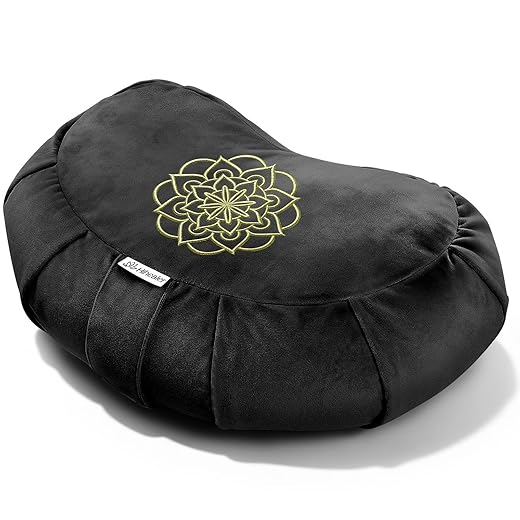
A crescent meditation cushion is a zafu-style meditation cushion with a curved front that creates a crescent shape. Unlike a round zafu, it has a front cutout that gives your legs a little more room.
It often works well for people who feel cramped on a traditional round cushion or want a shape that feels more accommodating for cross-legged sitting.
What makes a crescent meditation cushion different?
At first glance, a crescent meditation cushion may look like just a small variation on a traditional zafu, but its shape changes the way the cushion is built and how the seat area feels.
The main difference is not the material or the purpose of the cushion, but the shape itself. To understand what sets it apart, it helps to look at its outline, its surface feel, and how it fits within the broader zafu category.
The crescent shape
A crescent meditation cushion stands out because of its curved front edge. Instead of having a fully round shape, it has a gentle front cutout that creates a crescent-like form. That cutout changes the outline of the cushion and gives the front of the seat a more open feel.
The sides also extend differently than they do on a round cushion. Rather than forming one even circle, the shape creates a little more space around the front of the body, so the cushion feels less bulky where your legs naturally fold.
If you are new to meditation cushions in general, it helps to understand how this shape relates to a traditional zafu meditation cushion
How it feels different from a round shape
At a basic level, a crescent cushion feels more open at the front and more shaped around the sitting area.
A round cushion usually feels evenly shaped all the way around, while a crescent cushion has a more contoured surface. That does not automatically make it better or worse, but it does make it feel different as soon as you sit down.
Some people notice that a crescent cushion feels a little less uniform under the body, while a round cushion feels more symmetrical. To see the more classic form that this shape is often compared with, you can read about the round meditation pillow
Is a crescent cushion a type of zafu?
Yes. A crescent cushion is generally considered a type of zafu. The word “zafu” is often used broadly for meditation cushions that lift the hips off the floor, and the crescent version is simply one shape within that category.
So when people say “crescent zafu,” they usually mean a zafu-style meditation cushion with a curved front instead of a fully round form.
What does a crescent meditation cushion help with?
A crescent meditation cushion is designed to change the support underneath the body, not the meditation practice itself. Its shape can affect how the hips are lifted, how much space the legs have in front, and how the sitting position feels over time.
These functional changes are part of the broader role of meditation cushion benefits, but the crescent shape influences that support in its own way.
Helps elevate the hips
Like other zafu-style cushions, a crescent cushion can help raise the hips off the floor. That added lift can change the angle of the lower body and make floor sitting feel more supported. For some sitters, even a small amount of elevation can make the seat feel less flat and less demanding.
Can make cross-legged sitting feel less cramped
Because the front edge is curved inward, a crescent cushion can leave the front of the seat feeling more open.
For some sitters, that may make cross-legged sitting feel less crowded around the thighs and knees. The difference is not dramatic for everyone, but the shape can help create a little more breathing room in front of the body.
May support a more natural pelvic tilt
A crescent cushion can also help the pelvis rest at a slightly more workable angle. For some sitters, that may make it easier to settle the weight forward instead of collapsing backward into a slouched seat.
It does not force perfect posture, but it can help create a setup that feels more natural from the base upward.
Can reduce pressure in some sitting setups
In some sitting setups, the shape of a crescent cushion can make pressure feel more evenly managed across the seat and lower body. Some sitters find that the open front changes how the legs rest around the cushion, which can make the overall position feel less restricted.
That does not mean it removes discomfort on its own, but it can help the sitting arrangement feel more comfortable in certain positions.
Crescent vs round meditation cushion: what’s the actual difference?
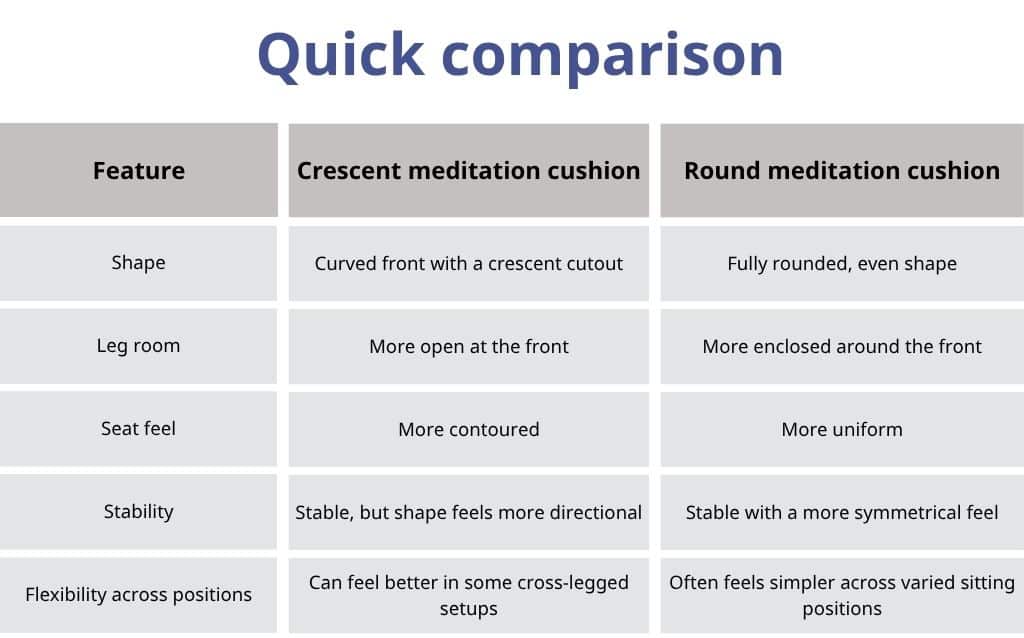
A crescent cushion and a round zafu serve the same general purpose, but they do not feel the same in use. The main difference comes from shape, and that shape changes leg room, seat feel, and how the cushion works across different sitting positions.
Shape
The most obvious difference is the outline. A crescent cushion has a front curve that creates a cutout shape, while a round zafu keeps the same basic form all the way around.
That design changes more than appearance. It changes how much space the front of the cushion leaves for the legs and how the seat feels under the body.
Leg room
A crescent cushion usually leaves more open space at the front. That can make the area around the thighs and knees feel less crowded.
A round cushion does not create that same front opening. Its shape feels fuller and more even, which some people like because it creates a more classic zafu feel.
Seat feel
A crescent cushion often feels more shaped or contoured. The sitting experience can feel slightly more defined because the cushion is not equally rounded on every side.
A round zafu usually feels more even and symmetrical. Instead of guiding the front edge of the seat, it offers a more consistent shape underneath the body.
Stability
Both shapes can feel stable when they are well made and properly filled. The difference is less about whether one works and more about how the support feels.
A crescent cushion may feel a little more directional because of its front cutout. A round cushion often feels more balanced in every direction because of its even shape.
Flexibility across sitting positions
A crescent cushion can feel especially natural in some cross-legged setups because of the extra space at the front. A round cushion may feel more neutral across different sitting positions because the shape does not suggest one front-facing layout as strongly.
Neither shape is automatically more versatile in every case. The difference is mostly about how each seat shape interacts with the position you naturally return to.
Who is a crescent meditation cushion best for?
This is the point where shape becomes personal. A crescent cushion is not the right match for everyone, but it can feel noticeably better for certain sitting patterns.
The easiest way to judge fit is to look at what usually happens when you sit down, where the position starts to feel awkward, and what kind of seat shape seems to give your body a little more room.
Beginners who feel cramped on a round cushion
You may prefer a crescent cushion if a standard round cushion feels bulky in front of you. Some beginners sit down on a round zafu and immediately feel like the shape takes up too much space where their legs want to fold.
In that case, the crescent shape can feel easier to settle onto because the front cutout creates a less crowded seat area.
A fuller guide to how to choose the right meditation cushion can help clarify whether the issue is really shape, height, or firmness.
People with tight hips
You may prefer a crescent cushion if your hips feel stiff early in the sit and the front of the cushion feels too full. Some people with tight hips are not looking for a softer cushion, but for a shape that feels less restrictive around the legs.
A crescent seat can feel more accommodating when the body does not naturally relax into a wide, easy fold.
Sitters whose knees stay relatively high
You may prefer a crescent cushion if your knees tend to stay noticeably higher than your hips and the seat already feels awkward within the first few minutes.
That does not always mean crescent is the full answer, but it can be a better fit when the front of a round cushion feels like it adds to the sense of crowding rather than easing it.
A practical meditation cushion height guide for beginners (chèn đến bài: Meditation cushion height guide for beginners) is also relevant here, because some fit problems come from seat height rather than seat shape alone.
Anyone who wants more room in front of the seat
You may prefer a crescent cushion if you simply like a seat that feels more open at the front. Some sitters do not dislike round cushions, but they feel more comfortable on a cushion that leaves a bit more space around the legs and thighs. In that case, the crescent shape may feel like a more natural fit from the start.
A crescent cushion may suit you if…
- you feel cramped on a traditional round cushion
- your hips feel stiff early in cross-legged sitting
- your knees stay relatively high and the seat feels crowded
- you prefer a cushion shape that feels more open at the front
With the basics in place, here are a few crescent cushions worth comparing.
When a crescent cushion may not be the right choice
A crescent cushion can be a great fit for some sitters, but not every discomfort comes from cushion shape. In some cases, choosing a crescent model does not solve the real problem and can even make the decision more confusing.
This part is about spotting those cases early, so you do not assume the shape itself is the answer.
If you prefer a fully even seat
A crescent cushion may not be the right choice if you prefer a seat that feels balanced and uniform all the way around.
Some people simply feel more settled on a cushion with an even surface and a symmetrical outline. In that case, the shaped front of a crescent cushion may feel too directional rather than naturally supportive.
If your main problem is cushion height
A crescent cushion may not be the right choice if the real issue is that your seat is too low or too high. Sometimes the problem looks like discomfort from shape, but the larger issue is that the hips are not positioned at a workable height.
In that situation, adjusting cushion height often matters more than switching from round to crescent.
If knee pain is your main limitation
A crescent cushion may not be the right choice if knee pain is the main reason sitting feels difficult. Shape can change how the seat feels, but it does not automatically solve pressure or strain at the knees.
A more useful starting point may be the broader question of meditation cushion support for knee pain, especially when discomfort shows up quickly or keeps returning.
If you may need a bench or a different setup
A crescent cushion may not be the right choice if floor sitting itself is the bigger obstacle. Some sitters do better with a completely different setup, especially when cross-legged positions feel limited from the start.
In those cases, the decision is less about crescent versus round and more about whether a bench or another support style makes better sense. That broader setup question is worth exploring in meditation bench vs cushion for knee pain
How do you sit on a crescent meditation cushion?
Using a crescent meditation cushion is less about finding a perfect pose and more about setting up the base of your seat correctly. The shape can help, but it still needs to be oriented well and matched to your body.
A few small adjustments in position can make the cushion feel much more stable and natural. Longer floor sessions also depend on the broader habits behind sitting longer in vipassana without your legs going numb, while seat setup is closely tied to overall meditation cushion height
Which side faces forward
The curved cutout usually faces forward. That open front is the part designed to leave more room for the legs, so the wider support sits behind you while the crescent opening sits in front.
A simple way to check is this: when the cushion is placed correctly, the front should look more open and the back should feel like the fuller part of the seat.
How high your hips should feel
Your hips should feel gently elevated, not perched too high and not dropped flat to the floor. In a workable setup, the seat should feel like it lifts the pelvis enough to make the position easier to settle into.
If your hips feel like they are sinking backward or collapsing into the lower back, the setup may be too low. If the seat feels unstable or overly steep, it may be too high for your current flexibility and position.
Where your knees should be
Your knees should feel supported by the floor or by your overall setup, rather than hanging in space without enough contact. In many cases, the position feels more settled when the knees rest lower than the hips or at least do not feel sharply lifted above them.
The goal is not to force the knees down, but to notice whether the lower body feels grounded and reasonably stable.
Signs your setup needs adjusting
Your setup may need adjusting if:
- you feel yourself rolling backward after a minute or two
- your lower back starts working hard to keep you upright
- your knees feel unsupported or awkwardly lifted
- your legs go numb very quickly in the same position
- the cushion feels bulky in the wrong place instead of supportive underneath you
When those signs show up, the issue is usually in the setup rather than in the intention to sit longer. Small changes in angle, height, or leg position often matter more than trying to hold still through discomfort.
What to look for before buying a crescent meditation cushion
Once the shape itself makes sense, the next question is whether a specific cushion will actually work in daily use.
At this stage, the most important details are practical: height, fill, firmness, maintenance, and weight. The feel of different fills becomes much clearer when you look at buckwheat meditation cushions,, while a broader shortlist of current options belongs in best meditation cushions
Height
Height is often the first thing to get right. A crescent shape can feel promising, but if the cushion sits too low or too high for your body, the overall setup can still feel off. A slightly taller cushion may feel better for people who need more lift, while a lower one may feel steadier for others.
Fill material
Fill changes both the feel and the maintenance of the cushion. Buckwheat hulls usually feel firmer, heavier, and more adjustable because many cushions let you remove or add filling.
Kapok tends to feel lighter and softer, with a less structured feel under the body. Some people prefer the grounded support of buckwheat, while others like the lighter feel of kapok.
Firmness
Firmness affects whether the cushion feels supportive or too compressible. A cushion that is too soft may flatten more than expected, while one that is very firm may feel less forgiving at first. The goal is not maximum softness, but a level of support that still feels stable once you settle into it.
Cover and maintenance
The outer cover matters more than it first seems. A removable cover is easier to keep clean, especially if the cushion is used often.
It is also worth checking whether the cover can be machine-washed and whether the inner cushion allows for refill access over time. These details make a difference in long-term use, not just first impressions.
Portability
Weight matters if you plan to move the cushion between rooms, take it to class, or store it away after each session.
Cushions filled with buckwheat are often heavier, while kapok-filled options are usually lighter. Neither is automatically better, but portability becomes important when the cushion is not staying in one place.

Now that you know what to look for, here are a few crescent meditation cushions worth comparing based on height, fill, and overall seat feel.


Should you choose a crescent meditation cushion?
A crescent meditation cushion is worth considering when the shape itself seems to solve a real fit problem, not just when it looks more comfortable at first glance. The goal here is to make the decision simpler.
Choose it if…
- you want more room at the front of the seat
- a round cushion tends to feel bulky or cramped around your legs
- you are trying to make cross-legged sitting feel more workable
- the crescent shape seems to match the way your body naturally settles
Skip it if…
- you prefer a seat that feels fully even and symmetrical
- your main issue is height rather than shape
- knee pain is the real reason sitting feels difficult
- a bench or a different meditation setup seems more appropriate
For a broader decision process, how to choose the right meditation cushion is the next useful step. A wider shortlist of current options fits naturally in best meditation cushions
FAQ
Is a crescent meditation cushion better than a round one?
Not necessarily. A crescent meditation cushion is not automatically better than a round zafu, and a round zafu is not outdated. The better choice depends on how each shape feels under your body and how much room you want at the front of the seat.
Can beginners use a crescent meditation cushion?
Yes. Beginners can use a crescent meditation cushion, especially if a round cushion feels bulky or awkward at the front. The shape can feel easier to settle into, although overall comfort still depends on the full setup rather than shape alone.
Is a crescent meditation cushion good for tight hips?
It can be. For some sitters, a crescent cushion feels less restrictive because the curved front leaves a more open area for the legs. That said, tight hips are not always solved by shape alone, so the overall seat setup still matters.
Do you need a zabuton with a crescent cushion?
Not always, but many people find it helpful. A zabuton adds padding under the knees, ankles, and lower legs, which can make floor sitting more comfortable, especially on hard surfaces.
What fill is best for a crescent meditation cushion?
There is no single best fill for everyone. Buckwheat is often preferred for a firmer, heavier, and more adjustable feel, while kapok is usually lighter and softer. The better option depends on whether you want a more grounded seat or a lighter, less structured one.