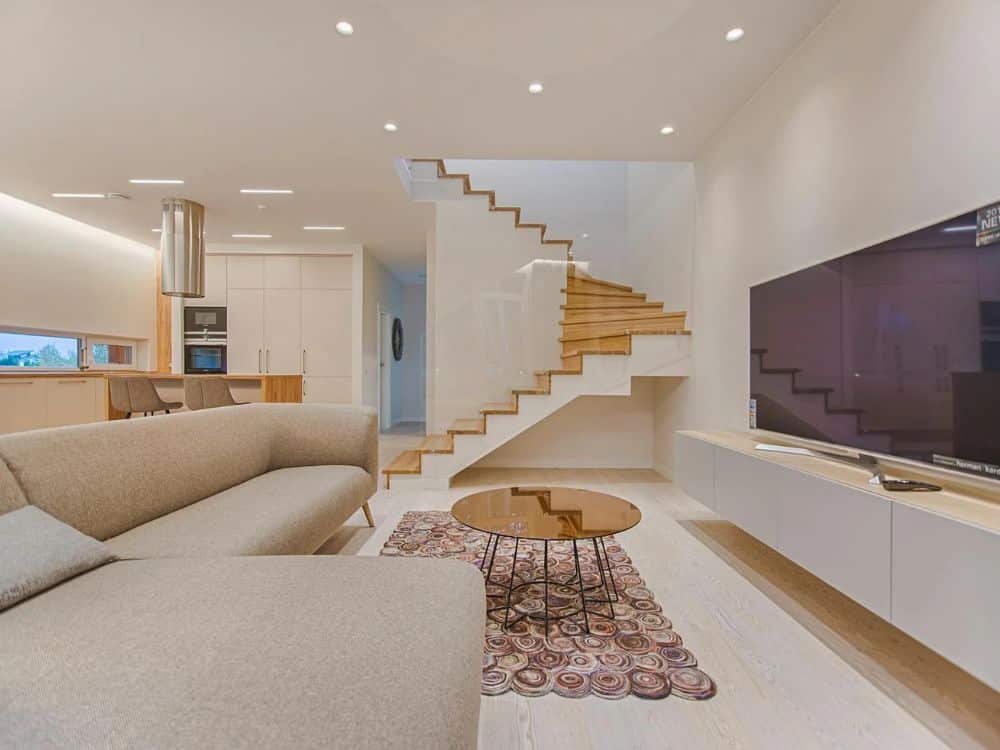
Ever sit down in your living room and feel like something just isn’t quite right – even though all the pieces are there? Often, the missing piece is knowing exactly how big should a rug be under a sofa, because the wrong size instantly throws off the balance of your space.
More often than not, the culprit is the rug. Too small, and your sofa looks stranded. Too big, and the room feels swallowed whole.
The good news? Rug sizing doesn’t have to be a guessing game. A few simple rules can instantly bring balance and style back into your space.
If you’ve ever unrolled a brand-new rug only to realize it feels “off,” you’re definitely not alone. It happens to homeowners all the time.
By the end of this guide, you’ll know exactly how big a rug should be under your sofa so your living room feels polished, cozy, and effortlessly put together.
So, what are the golden rules that can take your room from awkward to inviting? Let’s dive in.
How big should a rug be under a sofa?
Standard rug sizes available in the market
Ever stood in a store, completely overwhelmed by rug options? Yeah, me too.
Rugs usually come in a handful of standard sizes you’ll find across most retailers. Here are the most common:
- 2′ x 3′: Tiny, basically doormat size.
- 3′ x 5′: Small accent rugs, great for entryways.
- 4′ x 6′: Medium accent rugs.
- 5′ x 8′: The starting point for sofa-worthy rugs.
- 6′ x 9′: Great for apartments or smaller living rooms.
- 8′ x 10′: Perfect for medium-sized living rooms.
- 9′ x 12′: Ideal for larger living rooms.
- 10′ x 14′: Best for spacious, open-concept areas.
Custom sizes exist too, but they’ll cost you more than standard ones. Budget accordingly if you’ve got a uniquely shaped space.
Why rug size matters for room aesthetics
The wrong rug size can make a beautiful living room look like a hot mess – no joke.
Too small, and the room feels chopped up and disconnected. Your sofa ends up looking like it’s floating on a tiny island, totally separate from the rest of your furniture – as many designers note, a living-room rug should be large enough to ground at least the front legs of your sofa to keep proportions balanced.
Too large, and the rug overwhelms the space, making the room feel cramped and smaller than it really is. Kind of like wearing a coat that swallows you whole.
The right-sized rug, though? That’s magic. It ties everything together, defines your seating area, and creates visual harmony. It’s the difference between a room that feels thoughtfully designed and one that looks thrown together.
Yes, color and pattern matter – but size is what truly makes or breaks your room’s flow. Get the size right, and you’re already 80% of the way to a designer-level space.
The relationship between room size and rug size
Your room dimensions should always be the starting point when choosing a rug. Think of it this way: your room and rug need to be dance partners that complement each other.
- Small rooms (under 200 sq ft): An 8′ x 10′ rug usually works best.
- Medium rooms (200–300 sq ft): Go for a 9′ x 12′.
- Large rooms (300+ sq ft): You’ll likely need a 10′ x 14′ or bigger.
Here’s the key: leave breathing room. Aim for about 18–24 inches of bare floor between the rug’s edge and the walls. This frames your rug and anchors your furniture arrangement beautifully.
In open floor plans, use rugs to create zones. Your living room rug should define just the living area – not spill into dining or kitchen spaces.
And don’t forget shape. Rectangular rooms pair best with rectangular rugs, square rooms with square rugs, and circular rugs can soften spaces that have too many hard edges.
The front legs rule: minimum rug coverage
Ever walked into a room and something just felt… off? Chances are, it’s the rug-to-sofa ratio. That’s where the Front Legs Rule comes in – the simplest way to make your setup look intentional without overthinking it.
How to achieve the front-legs-only placement
This approach is straightforward: place your rug so it extends just enough for the front legs of your sofa to rest on it. The back legs? They stay on the floor. Think of it like dipping your toes into the water without diving all the way in.
To pull this off:
- Position your rug about 6–8 inches in front of your sofa.
- Make sure it extends at least 18 inches past the front legs.
- Center the rug with your sofa (unless you’re going for an intentionally asymmetrical vibe).
This setup creates a clean boundary – a subtle way of saying “here’s where the conversation area begins” without shouting it.
When this approach works best
Not every space needs the front-legs treatment, but it shines in:
- smaller living rooms where a massive rug would overwhelm the space, especially when you’re building a cozy home on a budget – thoughtful choices can make a modest rug feel intentional and warm.
- Budget-friendly decorating (smaller rug = smaller price tag).
- Rental apartments where you want to highlight hardwood floors.
- Rooms with unique flooring worth showing off.
- Spaces with multiple furniture groupings that need visual separation.
The Front Legs Rule gives you that “I know what I’m doing” designer touch – without breaking the bank or overpowering the room.
Measuring tips for front-legs placement
Measurements make all the difference here. Grab a tape measure and follow these steps:
- Measure the length of your sofa.
- Add about 12 inches to each side (24 inches total).
- For depth: start 6–8 inches behind the front legs, and extend the rug at least 18–24 inches in front.
For a standard three-seater sofa (around 84 inches long), you’ll usually land on a 5′ x 8′ rug. Got a sectional? Just make sure the front legs of each section sit on the rug.
The visual impact of this arrangement
Front-legs placement creates a very specific vibe. It’s like wearing ankle boots instead of knee-highs – enough to be stylish, while leaving some mystery.
This approach:
- Creates a balanced, intentional look.
- Makes the room feel bigger by showing more floor.
- Anchors your seating area visually.
- Lets the rug and flooring complement each other.
- Keeps the focus on your furniture while still layering in color and texture.
Partial coverage signals that your design was deliberate, not accidental. It’s stylish, smart, and works beautifully in spaces where a larger rug might feel suffocating.
The all legs approach: complete sofa coverage
Benefits of placing all sofa legs on the rug
Want to know the secret to a perfectly balanced living room? Put all four legs of your sofa completely on the rug. This isn’t just a designer’s whim – it’s a true game-changer for your space.
When every leg sits firmly on the rug, your seating area instantly feels intentional and unified, rather than randomly pieced together. The rug becomes the foundation that holds the entire conversation zone in place.
It also solves a sneaky problem: that awkward wobble when some legs are on the rug and others on bare floor. No one wants to spill their coffee because the sofa shifts every time someone sits down!
And stability isn’t the only perk. With heavy furniture anchoring it down, your rug stays put – no more flipped corners or rugs sliding out of place. The whole setup feels steadier and safer.
From a practical standpoint, this approach also protects your floors. The rug distributes the furniture’s weight evenly, preventing dents in carpet and scratches on hardwood.
Recommended rug extensions beyond the sofa
So how far should your rug extend? A good rule of thumb is at least 18–24 inches beyond each side of the sofa. It’s not arbitrary – this extra space balances the proportions and keeps the layout looking intentional.
At the front, give yourself even more: 30–36 inches. That way you’ve got room for a coffee table and space to walk comfortably around it. Plus, it feels undeniably luxurious when your feet land on soft rug instead of cold floor.
Behind the sofa, you don’t need as much. About 6–8 inches is usually enough – and if your sofa is flush against the wall, you might not need any extension at all.
How this style affects room perception
The all-legs-on approach completely changes how your room is perceived. First, it makes the space look bigger – and yes, more expensive. When furniture sits fully on a properly sized rug, the eye sees a cohesive, well-designed room.
In open-concept layouts, the rug also acts as a natural divider. It says “this is the living area” without the need for actual walls.
It even shifts color perception. A larger rug introduces a strong block of color or pattern that can either ground your design or become a stunning focal point, depending on what you choose.
And then there’s scale: sofas often look more substantial and well-proportioned when supported by a rug. It’s like giving your furniture its own stage to shine on.
Room-specific rug sizing guidelines
Living room configurations and ideal rug placements
Getting the right rug size for your living room isn’t rocket science – but it can completely change how polished your space feels.
For the classic setup with a sofa and a couple of chairs, you’ve got three main options:
- All legs on: This is the gold standard for designers. The rug should extend 12–18 inches beyond all sides of your furniture grouping, with every leg resting on it. This creates a cohesive, unified look. For most living rooms, that means at least an 8′ x 10′ or 9′ x 12′ rug.
- Front legs only: Tight on space or budget? This compromise works too. Position the rug so just the front legs of all seating pieces rest on it. You’ll still get that sense of connection while using a smaller (and often less expensive) rug. A 5′ x 8′ might be enough here.
- Floating rug: The rug sits under the coffee table but doesn’t touch any seating. Truth be told, this often looks like an afterthought – like you grabbed a rug on sale and tossed it in. Best to avoid unless you’ve got a bold, statement rug you want to showcase.
Open concept spaces vs. defined living areas
Open layouts call for different rug strategies than closed-off living rooms.
In open concept spaces, your rug acts like a boundary line: “this is where the living room begins.” Since there are no walls doing the job, size up – the rug should define the entire conversation area.
In defined living rooms (with actual walls), your rug’s role is simply to fill the space well. The architecture already marks out the room’s edges.
💡 Pro tip: In open layouts, avoid small rugs that float awkwardly in a vast space. Nothing says “I’m not sure what I’m doing” louder.
Sectional sofa considerations
Sectionals can be tricky – big, angular, and not always cooperative with standard rug rules.
For L-shaped sectionals, you’ve got two main choices:
- Rectangular rug: Position it so both sections of the sectional have at least the front legs on the rug.
- Custom or oversized rug: Some people opt for a custom shape that mirrors the sectional’s footprint.
For U-shaped sectionals, you’ll almost always need a large rectangular rug (10′ x 14′ or bigger), centered within the “U.”
⚠️ Reminder: with sectionals, a rug that’s too small looks worse than no rug at all. If budget is tight, it’s better to wait and buy the right size than to settle.
Multiple seating arrangements
In large living rooms or great rooms with multiple seating areas, you have two strategies:
- Use one oversized rug that encompasses all seating.
- Use separate rugs for each conversation zone.
If you go with multiple rugs, keep the style and color palette consistent, but they don’t need to match exactly. Sizes can vary as long as each rug feels proportional to its seating group.
For adjacent zones, keep rug edges at least 18 inches apart. Anything closer risks that “almost touching but not quite” look that makes a room feel cluttered and unplanned.
Common rug sizing mistakes to avoid
The too-small rug syndrome
You know that feeling when you’re wearing shoes just a size too small? That’s exactly what happens to your living room when the rug is undersized. It feels awkward, uncomfortable, and just… off.
The too-small rug is the #1 mistake I see in home setups. Picture this: a gorgeous sofa stranded on what looks like a postage stamp. That’s your 5′ x 7′ rug under a full-sized sectional.
When the rug barely reaches the sofa’s front legs, the whole setup looks disconnected – like the furniture is floating. The room feels chopped up and smaller than it actually is. It’s like wearing high-water pants: everything feels just a little wrong.
Quick test: if only your sofa’s front legs fit on the rug (or worse, none at all), you’ve got a classic case of too-small rug syndrome.
Ignoring furniture proportions
When it comes to rugs and sofas, size really does matter. They need to work together like best friends – not like strangers forced to share space.
I once had a client who bought a stunning 8′ x 10′ rug that looked perfect in the store. But once she unrolled it under her massive sectional, the rug practically disappeared. It looked like it was drowning under all that furniture.
Your rug should always match your sofa’s footprint. A tiny loveseat doesn’t need a 9′ x 12′ any more than a huge sectional can get away with a 5′ x 7′.
And don’t forget the rest of the furniture. If you’ve got a sofa plus two accent chairs, your rug should fit the whole arrangement – not just the couch.
Some designers follow the “minimum 8-inch rule”: let your rug extend at least 8 inches beyond your sofa on all sides. It’s a solid starting point if you’re unsure.
Neglecting walking paths
So you’ve measured your sofa and picked the perfect rug size. But did you stop to think about how people actually move through the room?
Nothing kills flow like tripping over a rug edge every time you walk by. Those edges can turn into invisible hazards right where people naturally step.
The worst offenders? Rugs that end halfway through a main walkway. Your feet go from soft rug to bare floor mid-stride – jarring, and it makes the room feel unplanned.
Remember, rugs aren’t just about looks. They help define traffic patterns in your home. A smart rug layout guides people smoothly through the space.
In open floor plans, your rug should either fully contain the walking path or avoid it completely. No awkward in-betweens.
Expert design tips for perfect rug-sofa harmony
Using rugs to define conversation areas
Ever walked into a room that just feels… right? Like everything has its place? That’s the power of a well-placed rug.
Rugs are secret weapons for carving out zones in your living space without building walls. In a large open-concept area, a rug under your sofa arrangement instantly says: “this is where the magic happens” – where people gather, talk, and connect.
The key is making sure your rug is large enough to anchor all the pieces in your conversation zone. Sofa, armchairs, coffee table – they should all feel like they belong to the same island. If the furniture looks disconnected, the energy in the room will too.
For a seamless setup, let your rug extend at least 6–8 inches beyond the seating on all sides. It creates an invisible boundary that says: “you’re in the living room now” – even in an open floor plan.
Layering techniques for unique looks
Boring rugs? No thanks. Layering is where things get interesting.
Start with a larger, simple base rug – natural fibers like jute or sisal work beautifully. Then layer a smaller, eye-catching piece on top. The mix of textures and patterns adds depth that a single rug can’t achieve, especially when you balance tones with the ultimate comfort palette to shape the room’s mood.
Here’s the formula:
- Base layer: Neutral, textured, and about 12–24 inches larger than the top rug.
- Top layer: Bold color or pattern, positioned to highlight your sofa’s central role.
The beauty of layering? You can swap out that top rug seasonally or whenever you crave a change. It’s like getting multiple rugs for the price of two.
Working with unusual room shapes
Not every room plays by the rules. L-shaped layouts, awkward corners, or tiny apartments all need a bit of strategy.
For L-shaped rooms, try:
- Two separate rugs to define different areas.
- One oversized rectangular rug to unify the space.
- A custom-cut rug that follows your room’s footprint.
In narrow rooms, run the rug perpendicular to the longest wall to create the illusion of width. And in small apartments, let the rug come almost to the walls (leaving 8–12 inches of bare floor). Counterintuitively, this makes the space feel bigger, not smaller.
Balancing pattern and size considerations
Here’s the truth: that gorgeous, bold pattern you love might not work once it’s scaled up under your whole sofa setup.
The larger the rug, the more subtle the pattern should be. Big, busy designs can overwhelm a space, while restrained ones help keep it balanced.
Still want that statement rug? Try:
- Using it as the top layer in a layered setup.
- Choosing a smaller size that fits under the coffee table.
- Pairing it with simple, clean-lined furniture to balance the visual energy.
Seasonal adjustment strategies
Your rug setup doesn’t need to stay the same all year. Just like your wardrobe, it can shift with the seasons.
In summer, go for lighter, breezier options – maybe a flat-weave cotton or an indoor/outdoor rug that feels cool underfoot. In winter, swap in something plush and cozy, like wool, for those movie nights.
The easiest seasonal swap? Layering. Keep a neutral base rug year-round, then rotate your top layer to match the season, your mood, or the latest trend you’re loving.
Pro tip: Store off-season rugs rolled (never folded) in breathable bags, with cedar blocks to keep moths away. Your future self will thank you when that perfect fall rug comes out fresh, smooth, and ready to roll.
My top amazon picks for perfect sofa rugs
Shopping for the right-sized rug can feel overwhelming. I’ve combed through Amazon to find rugs that work beautifully under sofas in different room setups. Here are my top recommendations, chosen for their quality, style, and value.
Stylish area rugs for living rooms
nuLOOM Moroccan Blythe Area Rug
A consistent bestseller, available in multiple sizes (the 8′ x 10′ and 9′ x 12′ are perfect for most sofa arrangements). The subtle pattern hides dirt while adding visual interest – and with over 25,000 glowing reviews, it’s a trusted pick. Soft underfoot yet durable enough for high-traffic areas.
Safavieh Madison Collection Boho Chic Area Rug
Available in sizes up to 12′ x 18′, this distressed, vintage-inspired rug pairs beautifully with both modern and traditional sofas. The low pile (0.3 inches) makes it practical for areas where doors need clearance.
Budget-friendly options
JONATHAN Y Moroccan HYPE Boho Vintage Area Rug
Starting around $120 for an 8′ x 10′, this rug delivers impressive style and durability for the price. Stain-resistant material makes it a smart choice for homes with kids or pets.
Artistic Weavers Chester Area Rug
A versatile, solid-colored option available in several neutral shades. Comes in the essential 8′ x 10′ and 9′ x 12′ sizes. At under $200 for larger dimensions, it’s a steal for the quality.
Plush Comfort Choices
Unique Loom Solo Solid Shag Area Rug
If comfort tops your list, this rug is a winner. With a 2-inch pile, it feels incredibly soft underfoot. The 8′ x 10′ size suits standard sofa arrangements, and the dense fibers hold up surprisingly well over time.
LOCHAS Ultra Soft Indoor Fluffy Area Rug
Perfect if you want that sink-your-toes-in feeling. While it does require more frequent cleaning, the comfort factor is hard to beat.
Durable picks for high-traffic areas
Ruggable Washable Rug
An innovative two-piece system with a rug pad and a washable cover. Though pricier than other options, the ability to toss the cover in the washing machine is a game-changer for busy households.
Maples Rugs Abstract Diamond Modern Distressed Area Rug
Made specifically for high-traffic zones. Its low profile makes it ideal for placing under sofas, while still extending the recommended 18–24 inches on all sides.
👉 Don’t forget to measure your space carefully before ordering. The good news? Most of these rugs come with free returns, so you can test them out risk-free and make sure they’re the perfect fit for your sofa setup.