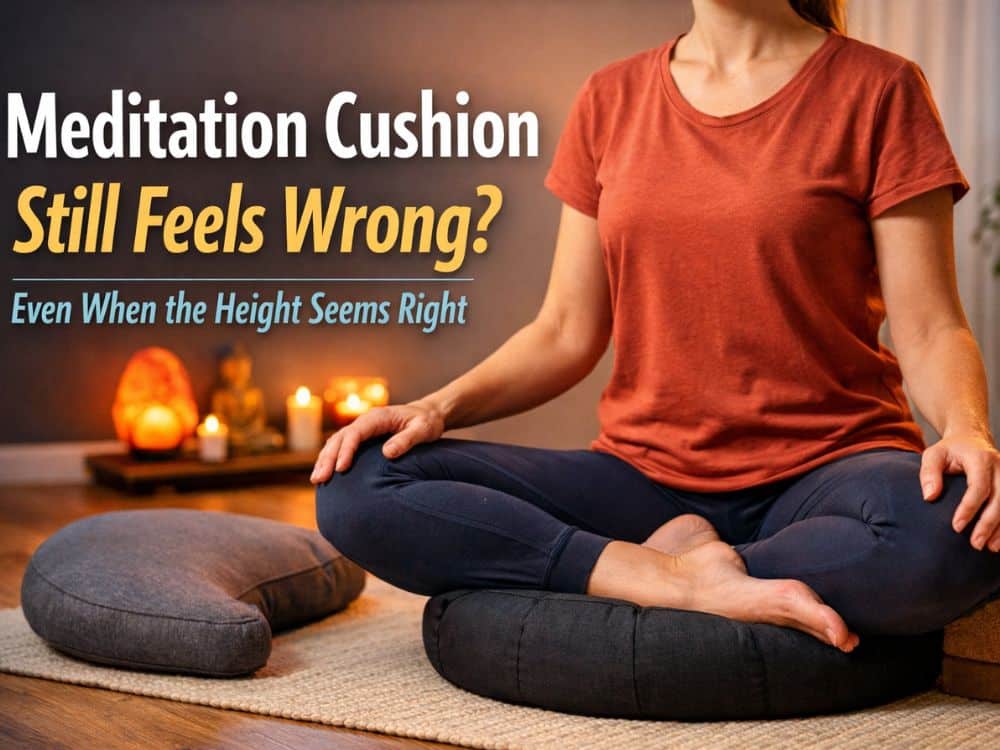
You have already tried sitting a little higher, then a little lower, and your cushion still does not feel quite right.
At that point, the problem is no longer just about cushion height. It may be the shape of the cushion, the way it compresses under your weight, the lack of support under your knees or ankles, or even the fact that floor sitting is asking more from your body than it can comfortably give right now.
That is why a setup can seem close to correct and still leave you feeling tense, unstable, or oddly uncomfortable after only a few minutes. If height adjustments have not solved the problem, the next step is not guessing harder. It is figuring out what part of the setup is still working against you.
Quick answer: when height is probably not the real problem
Sometimes the cushion height is close enough, but the setup still feels wrong because another part is doing the real damage.
A cushion can look fine on paper and still fail once your body settles into the sit. The quickest way to spot that is to stop asking, “Is this too high or too low?” and start asking, “What exactly gets worse, and when?
| What you feel | What it often points to | What to test next |
|---|---|---|
| You feel fine for a few minutes, then slowly sink and collapse | Compression or firmness problem | Try a firmer cushion or one that holds its shape better under your weight |
| Your knees feel okay, but your hips feel boxed in or restricted | Shape problem | Test whether a different cushion shape gives your thighs and hips more room |
| Your seat feels acceptable, but your knees or ankles hate the floor | Floor support problem | Add support under the knees, ankles, or shins before changing the seat again |
| One side always feels worse than the other | Body asymmetry or side-to-side loading issue | Notice whether the discomfort follows your body or the setup, and test one small support change at a time |
| Every floor setup feels bad no matter what you try | Floor sitting may not be the best tool right now | Consider whether a bench or chair creates less strain for your body |
This does not mean height never matters. It just means height is not always the part that needs fixing next. When the same discomfort keeps showing up after small height adjustments, the more useful question is which part of the setup is still working against your body.
If the cushion feels good at first but gets worse after a few minutes
A cushion that feels pleasant in the first minute can still be the wrong kind of support for a longer sit. This is one of the easiest ways to misread your setup. At first, everything seems fine.
Then your hips start sinking, your lower back works harder, or the whole posture begins to feel less steady than it did at the beginning. When that happens, the problem may be less about height and more about what the cushion is doing under load over time.
The cushion may be compressing too much under your weight
Some cushions feel comfortable at first because they are soft and forgiving on contact. But once your body settles, that softness can turn into collapse. Instead of keeping you supported, the cushion starts giving way under the heavier parts of your body, especially around the sit bones and hips.
That can make your posture feel less stable minute by minute, even if the setup seemed promising when you first sat down.
The key issue here is not whether the cushion feels soft. It is whether it still supports you after your weight has fully settled into it.
Soft at first does not always mean supportive for longer sits
This is where many people get confused. A cushion can feel cozy in the beginning and still make a longer sit harder. First-minute comfort and fifteen-minute support are not the same thing.
A very soft seat may reduce pressure at first touch, but it can also leave you doing more hidden work later as your body slowly loses structure and has to compensate.
That is why a setup that feels “nice” right away can still leave you fidgeting, slumping, or subtly bracing after a few minutes. The question is not just whether the cushion feels pleasant. The better question is whether it continues to feel stable as the sit goes on.
What to test next
If this sounds familiar, test one change at a time instead of replacing everything at once.
- Try a firmer fill that holds its shape better under your weight.
- Try a more structured base if the cushion feels too soft or unstable once compressed.
- Try a different material if your current one feels good on contact but loses support too quickly.
If you want to understand how different fills behave over longer sits, it helps to look at buckwheat hull meditation cushion adjustable fill benefits before assuming the problem is your posture.
If your hips feel trapped even though the height seems fine
Sometimes the cushion height is close enough, but your body still never quite settles. Your knees may not be the problem. Your lower back may not be collapsing right away.
And yet your hips feel boxed in, crowded, or strangely tense instead of supported. When that happens, the issue may be less about lift and more about whether the cushion shape actually gives your body enough room to rest naturally.
A round cushion does not fit every body equally well
A traditional round seat can work beautifully for some people, but it is not automatically comfortable for everyone. Depending on your hip structure, thigh angle, and sitting pattern, a round cushion can sometimes feel too contained.
Instead of helping the legs fall away naturally, it may keep the hips feeling perched on top of a small surface. If you are unsure what shape you are working with, it helps to understand the zafu meditation cushion definition before assuming the problem is still the height.
Some bodies need more room for the thighs to settle
Even when the lift feels acceptable, the front edge and side shape of the seat can change how easily the thighs relax. If the cushion does not give enough space for the legs to angle down comfortably, the hips can stay tight and slightly guarded through the whole sit.
That tension often feels vague at first. You may not think “this shape is wrong.” You just notice that your body never fully drops into the posture.
When a crescent shape feels easier than a round seat
For some people, the problem improves as soon as the cushion gives the thighs a bit more space. A crescent shaped meditation cushion often feels easier because the cut-in front creates more room for the legs and reduces that boxed-in feeling around the hips.
It does not work better for everyone, but if a round seat always feels slightly restrictive, shape may be the next thing to test.
If you keep correcting your posture but the sit still feels forced
Some sits look reasonable from the outside and still feel wrong from the inside. You lift the chest, soften the shoulders, lengthen the spine, and keep making small corrections, but the posture never quite settles. Instead of feeling supported, you feel managed.
When that keeps happening, the problem may not be that you need better cues. It may be that the setup is asking for too much effort just to maintain something that should feel more natural.
A setup can be technically “correct” and still feel unsustainable
This is where many people get stuck. They can follow the usual advice, make the posture look tidy, and still feel like they are holding it together rather than resting into it.
A setup can be technically acceptable and still be too demanding for the body over time. If staying upright depends on constant adjustment, the posture may be workable in theory but unsustainable in practice.
When too much effort is the clue
Effort itself is useful information. If you keep correcting your spine, repositioning your pelvis, or trying to relax tension that immediately comes back, that is not always a discipline problem.
Sometimes it is a sign that the setup is not giving you enough support in the places that matter most. The body keeps compensating because it does not trust the seat yet.
If your posture only works when you keep actively managing it, that is already a clue. A setup that fits you reasonably well should not require constant rescue. The goal is not to hold yourself together more skillfully, but to reduce how much unnecessary effort the sit demands from you.
The goal is not a prettier posture, but less internal resistance
A meditation posture does not need to look impressive to be useful. What matters more is whether the body can stay in it without building layer after layer of hidden tension. Less internal resistance usually means less bracing, less fidgeting, and less need to keep correcting the same thing over and over.
If that is where the struggle keeps showing up, it may help to explore support options closer to best meditation cushion for back pain rather than assuming the answer is simply better posture discipline.
If one side always feels worse than the other
Sometimes the problem is not that the whole setup feels wrong. It is that one side always seems to complain first.
One hip tightens sooner, one knee feels more loaded, or one side of the lower back starts working harder even when the posture looks fairly even. That kind of pattern is easy to dismiss, but still sitting tends to make small differences much more obvious.
Your body may not load both sides evenly
Even when your seat looks centered, your body may not actually be settling into it in a perfectly balanced way. One side may carry more weight, hold more tension, or resist the position a little earlier than the other.
This does not automatically mean something is seriously wrong. It just means the discomfort may be coming from how your body meets the setup, not only from the setup itself.
Small asymmetries become obvious during still sitting
When you stay still, the body loses the little adjustments that usually hide minor imbalances. A side that feels “slightly tighter” in everyday movement can become much more noticeable during meditation because there is no constant motion to spread the effort around.
That is why one-sided discomfort can show up even when the cushion seems generally fine.
Test the setup before blaming flexibility
Before you assume one side is simply less flexible, test a few small variables in a practical way.
- Notice which side tightens first and where it happens.
- Test a small support change under one knee and see whether the discomfort shifts.
- Rotate the seat orientation and check whether the same side still feels worse.
- Pay attention to whether the issue follows your body or seems tied to the cushion setup.
If the same pattern keeps following your body, the setup may not be the whole story. But if the discomfort changes when you make a small support change, that is useful information too.
The goal here is not to diagnose everything at once. It is to stop guessing and see whether the pattern stays the same or changes when the setup changes.
When cross-legged sitting is the real problem, not the cushion
Sometimes the cushion is not the thing that keeps failing. The real issue is that cross-legged floor sitting is still asking more from your body than it can comfortably give right now. In that situation, even a decent setup can keep feeling “almost right” but never truly sustainable.
That is why endless tweaking can become frustrating: you keep changing the seat, but the posture itself is still doing most of the damage.
Some bodies are not ready for comfortable floor sitting yet
This is not a moral failure, and it does not mean you are doing meditation wrong. Floor sitting asks for a mix of hip mobility, joint tolerance, and passive comfort that not every body has at the same time.
Some people can settle into it fairly easily. Others keep meeting the same wall no matter how carefully they adjust the setup.
If cross-legged sitting keeps feeling strained no matter how much you tweak the cushion, the posture itself may be asking too much from your body right now.
That does not mean you need more willpower. It may simply mean you need a sitting option that demands less from your hips, knees, and lower back.
Forcing the posture can make every cushion feel wrong
This is where people often misread the problem. They assume the next cushion, the next height, or the next small adjustment will finally unlock comfort.
But if the body is already working hard just to stay in the posture, every seat can start to feel disappointing. The setup may not be perfect, but it is not always the main reason the sit feels forced.
This becomes even more obvious during longer, quieter sits, when small strains have time to build into real resistance.
That is one reason people searching for the best meditation cushion for vipassana sometimes discover that the deeper problem is not the cushion alone, but how demanding cross-legged sitting becomes over time.
When a bench makes more sense than more tweaking
At some point, more tweaking stops being useful. If you have already adjusted the cushion and the sit still feels like a fight, it may be more helpful to change the sitting tool than keep trying to rescue the same posture.
For some people, that is the point where meditation bench vs cushion becomes a more useful question than “What should I change on this cushion next?”
A better setup is not the one that looks more serious. It is the one that lets the body settle with less effort and less resistance.
What to change next, in the right order
When a meditation setup feels off, it is easy to change the wrong thing first. Many people jump straight to a new cushion, a new shape, or a new posture without checking what is actually failing.
A better approach is to work through the setup in order, from the most immediate support issue to the biggest change in sitting style.
If your setup still feels wrong, do not change everything at once. Start with what affects support most directly, then move outward. Check collapse first, then shape, then floor support, then how long you are trying to sit. Only after that should you decide whether you need a different sitting tool altogether.
Change firmness before chasing another shape
Start with the question that is easiest to miss: does the cushion still support you after your full weight settles into it?
Check for signs like these:
- the seat feels fine at first, then slowly loses structure
- your hips sink more than you expect after a few minutes
- your posture feels less steady over time, even without a major position change
If that is happening, the next adjustment is probably firmness, fill, or structure, not shape.
Change shape before assuming you need a totally different body
If the cushion is holding up reasonably well but your hips still feel boxed in or your thighs never quite settle, shape becomes the better question.
Look for clues such as:
- the seat feels stable, but the front edge never feels natural
- your hips stay tense even when the support level seems acceptable
- you keep feeling crowded rather than supported
At that point, it makes more sense to rethink the seat form than to assume your body is the problem.
Change the floor support before judging the whole setup
If the seat feels mostly acceptable but discomfort builds where your body meets the ground, the setup may still be incomplete even if the cushion itself is decent.
Notice whether:
- your knees or ankles become the limiting factor
- the seat feels better than the lower contact points
- you want to stop because of pressure below you, not because the seat feels wrong
Before judging the whole setup, make sure the floor is not the part that is quietly ruining the sit.
Change the sitting tool if floor sitting keeps failing
Sometimes the problem is not a small adjustment. It is the fact that floor sitting keeps demanding more than your body can comfortably give. If you have already checked support, shape, and floor contact – and the sit still feels like a struggle – it may be time to step back and think more broadly about the setup.
That is the point where how to choose a meditation cushion becomes less about finding one perfect product and more about choosing the kind of support your body can actually work with.
A better decision is not always “try harder with the same posture.” Sometimes it is “use a setup that asks less from you.”
FAQ
Why can the most comfortable meditation cushion still feel wrong after a few minutes?
This usually happens when initial softness feels good at first contact but does not provide enough lasting support once your full weight settles. Comfort in the first minute and comfort through the whole sit are not always the same thing.
Can a beginner still choose the wrong meditation cushion even if the height seems okay?
Yes. Height is only one part of the setup. A beginner can still struggle if the cushion shape feels restrictive, the fill collapses too much, or floor sitting itself is asking more from the body than expected.
Why does a cushion feel fine for sitting comfortably at first, but not during longer sessions?
Short sits can hide problems that show up later. Compression, shape mismatch, and hidden tension often become much more noticeable once the body stays still long enough.
When do longer meditation sits reveal a setup problem more clearly?
They usually reveal it when the body stops making small unconscious adjustments. That is why a setup can seem acceptable during a brief sit but start feeling forced, unstable, or tiring during longer practice.
How do I know whether I need a different cushion or a different sitting tool?
If you have already tested firmness, shape, and basic support and the sit still feels strained, the problem may not be the cushion alone. At that point, changing the sitting tool can make more sense than continuing to tweak the same setup.
Can a cushion for Vipassana still feel wrong even if it looks supportive?
Yes. Longer and quieter sits expose flaws that shorter sessions hide. A setup may look stable from the outside and still create too much tension once you remain still long enough.