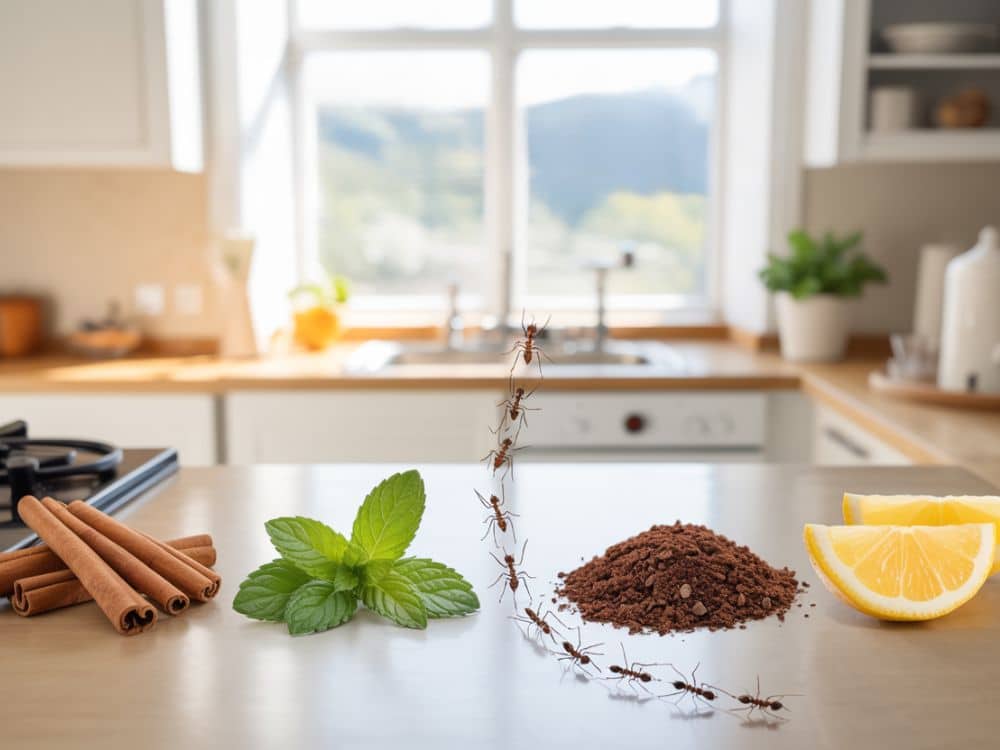
Ever left out a plate of food, only to watch ants march in like uninvited guests who never miss a crumb?
These tiny creatures can turn a cozy kitchen or a sunny picnic into a battlefield, leaving you feeling frustrated and outnumbered.
The good news? Ants have certain smells they can’t stand. With the right scents, you can send them packing – no harsh chemicals needed.
If you’re tired of wiping up ant trails or guarding your snacks like hidden treasure, you’re not alone. We’ve all been there.
In this post, we answer What Smell Do Ants Hate the Most? – and share simple, practical ways to use those scents to keep your home and gatherings ant-free.”
So, what’s the secret scent that works on almost every species of ant? Let’s find out.
Understanding ant behavior and scent detection
How ants use scent for navigation and communication
Ever noticed how ants march in neat little lines? That’s not just discipline – it’s navigation. Ants follow invisible highways made of scent. These chemical trails, called pheromones, are their way of talking to each other.
When one ant finds food, it lays down a trail of pheromones on its way back to the nest. The message is clear: “This way to dinner!” Other ants pick up the scent and follow it straight to the source.
It’s like leaving breadcrumbs – except these chemical breadcrumbs can also say, “Danger ahead!” or “This way home!”
In fact, ants use different pheromones for different purposes:
- Food trails: “Fresh food here!”
- Alarm signals: “Watch out – something’s wrong!”
- Home markers: “This path leads back to the nest.”
- Territory markers: “This land belongs to us.”
Their antennae act like tiny super-powered noses, picking up these signals with astonishing precision. An ant can tell whether another ant is a nestmate or an intruder in a split second – just by scent.
Why certain smells repel ants
So why do ants hate certain smells? Because strong odors mess with their finely tuned communication system.
A powerful scent can mask or disrupt pheromone trails, leaving ants confused and disoriented. Imagine trying to follow directions while someone blasts heavy metal in your headphones – it’s overwhelming.
Some scents even mimic alarm pheromones, triggering a “danger” response. The ants panic and scatter, convinced there’s a threat. Others simply overwhelm their sensitive receptors, making it impossible to detect vital colony signals.
The most effective ant-repelling scents tend to fall into a few categories:
- Strong citrus oils (lemon, orange, grapefruit)
- Pungent herbs (mint, lavender, rosemary)
- Spices (cinnamon, cayenne, black pepper)
- Acidic substances (vinegar, certain essential oils)
These don’t just cover up ant trails – they actively scramble the system ants rely on to survive as a colony.
The science behind their super sense of smell
For creatures so small, ants have a mind-blowing sense of smell. Their olfactory system can detect chemicals in concentrations as low as a few parts per trillion – that’s like spotting a single grain of sand on an entire beach.
The secret lies in their antennae, which are lined with thousands of tiny sensory receptors. Each receptor is like a lock, waiting for the right chemical “key.” When a molecule fits, it triggers a signal to the ant’s brain, which instantly interprets it as a specific message.
What’s even more fascinating is how precise this system is. Ants can distinguish between hundreds of pheromones that may differ by only a molecule or two. Their brains have specialized centers devoted solely to decoding these scents.
So when we introduce strong, repellent odors, we’re basically jamming their entire communication network. Their finely tuned receptors get overwhelmed, leaving them unable to pick up the subtle signals that normally guide their every move.
What smell do ants hate the most? The most powerful natural ant repellents
Citrus oils and their effectiveness against ants
Ants absolutely can’t stand citrus oils. That sharp, zesty scent we find so refreshing? To them, it’s a nightmare.
Orange, lemon, and grapefruit oils all contain d-limonene, a compound that destroys the waxy coating on an ant’s respiratory system – essentially suffocating them. Intense, right?
A simple DIY spray works wonders: mix 15–20 drops of lemon or orange essential oil with a cup of water, then spritz along windowsills, entry points, or anywhere you’ve spotted a trail. Ants will retreat faster than you can say “scram!”
The bonus? Your home ends up smelling bright and citrusy, not like chemicals. A win-win.
Vinegar solutions that drive ants away
Vinegar is the unsung hero of ant control. Its strong acetic acid scent completely disrupts the pheromone trails ants rely on for navigation
And the University of Minnesota Extension notes that wiping ant trails with a mild vinegar-water solution can temporarily interrupt their activity. Spray vinegar around, and suddenly that trail vanishes – it’s like erasing their GPS system. Just mix equal parts white vinegar and water in a spray bottle.
One quick note: avoid using vinegar on marble or stone surfaces, since the acid can cause damage. Otherwise, it’s cheap, effective, and already sitting in your pantry.
Peppermint oil: the ant’s worst enemy
If ants had a sworn enemy, it would be peppermint oil. The strong menthol scent overwhelms their senses, blocking their ability to detect food or follow pheromone trails.
To us, it’s refreshing. To them, it’s unbearable.
To make a barrier, combine 10–15 drops of peppermint essential oil with a cup of water in a spray bottle. Mist it around windows, doors, cracks, and other entry points.
Or soak cotton balls in peppermint oil and tuck them into corners and cabinets – a budget-friendly habit that keeps your home calm and comfortable while you deter trails naturally.
I’ve watched ants do complete U-turns when they encounter peppermint. The effect is almost instant – like tiny marathon runners realizing they’re on the wrong track.
Cinnamon and cloves as potent deterrents
The cozy scent of holiday baking might make us feel warm inside, but for ants? It’s chaos.
Cinnamon and cloves contain compounds that disrupt ants’ navigation, making it hard for them to stay organized. You can:
- Sprinkle ground cinnamon along windowsills, thresholds, or cracks.
- Place whole cloves in cabinets or near entry points.
- Use cinnamon sticks in pantry corners as a natural guard.
For a stronger solution, mix cinnamon essential oil with a little water to form a paste and spread it where ants sneak in. They’ll steer clear.
Coffee grounds as a natural barrier
Before tossing out your used coffee grounds, put them to work. Ants dislike both the smell and the texture – the rough grains irritate them, and the scent masks their pheromone trails.
Once dried, sprinkle grounds:
- Around garden beds,
- Along the base of your home,
- Or near entry points.
Some compounds in coffee may even be toxic to certain ant species. And as a bonus, coffee grounds enrich the soil as they decompose, feeding your plants while protecting them. Nature’s multitasker at its best.
Chemical Compounds Ants Avoid
Strong acids and why ants detect them as threats
Ever noticed how ants scurry away the moment they hit a splash of vinegar? That’s no coincidence – they’re hardwired to avoid strong acids.
Ants live by chemical communication, with their antennae serving as finely tuned detectors. When they encounter acids like vinegar, citric acid, or lemon juice, their receptors go into overdrive. To ants, these aren’t just bad smells – they’re warning signals.
The connection with formic acid makes it even more intriguing. Ants actually produce formic acid as part of their own defense system (that burning sting you feel from an ant bite? That’s it). So when they detect other acids, they interpret them as a red alert, almost like another ant signaling: “Danger ahead!”
That’s why acidic solutions – anything with a pH below 7 – don’t just mask trails. They actively disrupt communication and convince ants your space is unsafe territory.
Capsaicin (hot pepper) compounds that irritate ants
Hot peppers make us sweat, but for ants, they’re unbearable. The fiery kick in peppers comes from capsaicin, and while humans taste it, ants feel it.
When ants come into contact with capsaicin, it causes an intense burning-like irritation across their exoskeleton and antennae – like tiny sparks firing all over their bodies. Naturally, they turn the other way.
Cayenne pepper, chili powder, and other spicy substances make effective repellents because they:
- Disrupt ants’ ability to follow chemical trails
- Overload their sensitive communication systems
- Stick to their bodies, prolonging the irritation
The beauty of capsaicin is that it doesn’t kill ants – it just makes the area too uncomfortable to stick around. That means you can protect your home without upsetting the ecosystem.
Diatomaceous earth and how it affects ant behavior
At first glance, diatomaceous earth looks like fine white powder. But under a microscope, it’s more like a field of glass shards. Made from fossilized algae, it has razor-sharp edges at the microscopic level.
When ants walk across it, they don’t notice the danger right away. But the particles cling to their bodies, slowly:
- Cutting through their protective exoskeleton
- Absorbing the oils that keep them hydrated
- Leading them to dehydrate and weaken
As the damage sets in, ants release alarm pheromones, warning others to steer clear. Even though diatomaceous earth has no scent for us, ants quickly mark it as a “no-go zone.” Before long, the colony learns to avoid treated areas entirely.
It’s almost like creating an invisible barrier – one that ants can sense, but we can’t.
Quick guide: How different compounds repel ants
| Compound / Substance | How It Works on Ants | Best Use |
| Strong Acids (vinegar, lemon juice) | Ants detect acids as chemical danger signals, disrupting pheromone trails and making areas feel unsafe. | Spray diluted vinegar or citrus solutions on entry points, countertops, and ant trails. |
| Capsaicin (cayenne, chili, hot peppers) | Causes intense irritation on ants’ exoskeleton and antennae, overwhelming their senses. | Sprinkle powder near cracks, baseboards, or mix into a spray for outdoor use. |
| Diatomaceous Earth (food-grade) | Microscopic sharp particles cut through ants’ waxy coating, dehydrating them over time. | Dust around foundations, garden beds, and along paths ants frequent (safe for pets if food-grade). |
Using scent barriers to protect your home
Creating effective perimeter treatments with repellent scents
Ants dislike certain smells so much that they’ll detour around them entirely. Smart homeowners can use this to their advantage by creating scent barriers – natural lines of defense that ants refuse to cross.
The most reliable repellents include peppermint oil, vinegar, citrus oils, and spices like cinnamon.
- Peppermint oil spray: Mix 15-20 drops of peppermint oil with 2 cups of water in a spray bottle. Mist along baseboards, entry points, and windowsills. The strong menthol scent scrambles their scent trails and makes them retreat.
- Vinegar solution: Combine equal parts vinegar and water, then spray around door frames, cracks, and other potential openings. The acidic smell erases pheromone trails instantly.
- Dry spice barriers: Sprinkle cinnamon, black pepper, or cayenne across thresholds or cracks. Ants can’t stand these pungent spices and will avoid crossing them.
Strategic placement for maximum effectiveness
The secret to scent barriers isn’t just what you use – it’s where you use it. Think like an ant scout, and you’ll know where to focus.
- Entry points: Spray or sprinkle along doorways, windows, foundation cracks, and utility openings; in compact homes, a few smart hacks make it easier to keep these lines of defense clear.
- Indoor trails: Target baseboards, countertop edges, and wall corners – these are the highways ants love.
- Kitchen zones: Protect food storage, the space behind appliances, and the area under sinks – prime ant treasure spots.
- Outdoor perimeters: Create a 3-foot-wide barrier around your home’s foundation. Stop them outside before they even consider coming in. Pairing these scent barriers with simple routines – like cleaning entry points and sealing cracks – reinforces the same foundation that keeps all pests from feeling at home naturally.
Combining scents for stronger repellent action
Sometimes one smell isn’t enough. In those cases, a scent cocktail can overwhelm ants completely.
- Peppermint + Lemon: 10 drops of each in a spray bottle of water. A refreshing scent for you, but unbearable for ants.
- Vinegar + Essential Oils: Vinegar disrupts their trails, while oils like tea tree or lavender add an extra “keep out” signal.
- Cinnamon + Clove: Sprinkled together, these spices create overlapping aromas that ants can’t decode, forcing them to retreat.
How long different scent barriers last
Not all barriers have the same staying power – knowing when to reapply makes all the difference.
- Essential oils: Potent but short-lived; reapply every 2–3 days, or sooner after cleaning.
- Vinegar solutions: Lasts 3–5 days, but washes away easily with moisture.
- Dry spices: Indoors, they can work for 1–2 weeks if left undisturbed. Outdoors, they fade quickly after rain or dew.
- Diatomaceous earth + oils: A powerful combination that provides both a scent and physical barrier, staying effective for several weeks.
Testing different repellents: what works best
Laboratory findings on ant repellent effectiveness
When scientists put ants to the test in controlled lab settings, the results are clear: some smells consistently send them running.
- Peppermint oil usually tops the charts. In one study, 90% of ants refused to cross a peppermint oil barrier. That’s a serious shut-down.
- Citrus oils (especially lemon and orange) scored nearly as high, with around 85% repellent rates.
- Other common contenders like vinegar, cinnamon, and clove showed solid – though slightly lower – results.
Here’s how major repellents stacked up in recent lab experiments:
| Repellent | Effectiveness Rate | Duration |
| Peppermint | 90–95% | 3–5 days |
| Citrus oils | 82–88% | 2–3 days |
| Vinegar | 75–80% | 1–2 days |
| Cinnamon | 70–78% | 2–4 days |
| Clove | 65–75% | 3–4 days |
Interestingly, tea tree oil showed mixed results: very effective (about 88%) against carpenter ants, but only moderately effective (around 60%) against sugar ants.
Real-world application success rates
Of course, lab results don’t always translate perfectly to your kitchen floor.
- Peppermint oil still performs well, but its effectiveness drops to around 70–75% in homes. Factors like air circulation, surface materials, and competing odors make a difference.
- Vinegar solutions actually do better in real-world trials than in labs – many homeowners report about 80% success when they reapply consistently.
- The biggest real-world winner? Combinations. A DIY mix of vinegar, peppermint oil, and water outperformed single ingredients by roughly 15%.
One key insight: persistence matters more than sheer potency. Regularly reapplying medium-strength solutions tends to work better than one-time “blast” treatments with stronger ones.
Different species and their varied scent aversions
Not all ants react the same way to every repellent. Species differences matter – a lot.
- Carpenter ants: Hate eucalyptus (92% avoidance in studies).
- Fire ants: Resistant to most scents, but cinnamon and clove oils trigger strong avoidance.
- Pharaoh ants (the tiny pale ones): Particularly sensitive to citrus.
- Black garden ants: More strongly repelled by mint-family scents.
This explains why your neighbor swears by lemon juice while peppermint spray works best for you – you’re probably battling different species.
Temperature also plays a role. In warmer months, ants show stronger reactions to scents, making repellents more effective than during cooler weather.
The most universal repellent across species? White vinegar with a few drops of peppermint oil. It consistently shows at least moderate success against nearly every common household ant.
Amazon ant repellent products that actually work
Ants can’t stand certain smells, and luckily, plenty of products on Amazon use those scents to keep them out of your home. After testing dozens of options, I’ve narrowed it down to the ones that actually deliver results.
Essential Oil-Based Repellents
The market is full of essential oil sprays, but few live up to their promises. One standout is Mighty Mint Insect & Pest Control.
Made with peppermint oil, it creates a barrier ants won’t dare cross. A 16oz bottle lasts surprisingly long since you only need a light spray every few days. Bonus: the minty scent is pleasant for us, even if ants despise it.
Another winner is Wonder Soil Cedarcide. Cedar oil ranks high on the list of smells ants hate, and this spray delivers it without the harsh chemical stench of traditional pesticides. It’s also safe to use around kids and pets – a big plus.
Diatomaceous Earth Products
For staying power, Harris Diatomaceous Earth is a classic. While it doesn’t work through smell, this fine powder creates an invisible, deadly barrier for ants by dehydrating them. A 4-pound bag (with a handy duster included) costs about $15 and easily lasts through multiple ant seasons.
Ant Baits With Repellent Properties
If you’re battling stubborn colonies, TERRO T300B Liquid Ant Bait is a tried-and-true option.
It uses a borax-based formula to attract ants, while the added citrus compounds help discourage new colonies from setting up shop. A 6-pack costs around $12 and is enough to cover multiple problem areas in your home.
Natural Vinegar Solutions
For a two-in-one cleaner and repellent, Aunt Fannie’s Vinegar Wash is a great choice. The vinegar wipes out ant scent trails while essential oils add an extra punch. You can use it as an everyday cleaner and, at the same time, keep ants from marching across your counters.
Cinnamon-Based Options
If you prefer something simple and natural, Hot Foot Cinnamon Ant Deterrent is both effective and convenient.
Packaged in a shaker bottle, it makes sprinkling easy – whether along garden perimeters, basement entryways, or kitchen cracks. At around $20 for a large container, it’s a cost-effective way to protect bigger areas.
Nothing is more frustrating than buying a product that doesn’t work. These Amazon picks have proven track records, all based on scents ants can’t tolerate. The best part? Most ship with Prime, so you can have your defenses in place within a couple of days – no more waiting while ants take over your snacks.
Drive ants out – naturally
Ants live by scent – and that’s exactly what you can use against them.
From citrus oils rich in limonene to vinegar with acetic acid, from peppermint and cinnamon to tea tree and eucalyptus, these natural scents break apart pheromone trails and overwhelm the ants’ sensitive “noses.”
The strategy is simple:
- Build a barrier. Keep it fresh. Stay consistent.
- Spray vinegar along entry points.
- Dab peppermint oil on door frames and windowsills.
- Dust cinnamon where sprays don’t reach.
- Reapply after cleaning or rainy weather.
By choosing natural repellents, you can skip harsh pesticides while still protecting your home – and keep your kids, pets, and the environment safe.
Start today. Pick your scent. Treat the trails. Seal the gaps.
Your space can be ant-free – without chemicals, without stress, and without compromise.